

Please fill out the form below to access our Translation Options Hotsheet:
Last week, a group of Key Worker kids embarked on a cross-curricular project centred on cryptids – creatures whose existence is disputed, or considered rumour by scientists. Their objective seemed simple at first; decide whether one of the most infamous cryptids – the Loch Ness Monster – could really exist. A preliminary vote suggested that the overwhelming majority thought ‘no’, but after a week’s exploration, we were no longer so sure of our assumptions…
LITERACY
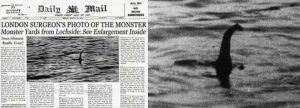 We began with a literary leap into the mythology of the Loch Ness Monster. From its first alleged sighting by St. Columba in 565 CE, to the famous ‘Surgeon’s Photograph’, to a set of strange sonar readings and the alleged sightings on Apple maps. Each account compounded the mystery surrounding the creature. There were so many sightings, so much apparent evidence, but there were also a whole host of hoaxes and make-believe reports. We needed more information. Cue a ‘fact’ finding mission!
MATHS
 The group undertook a research task, compiling comparative information for a collection of cryptids, namely the Yeti, the Beast of Bodmin Moor, Bigfoot, and of course, Nessie itself. They used their ICT skills to compile a database of ‘facts’ for each creature, including its size, place of origin, year of earliest sighting and even their number of limbs! This comparison showed that Nessie was much larger than her monstrous counterparts, and as such, should be much easier to spot! So, why are sightings of Nessie so infrequent, and so fleeting? Maybe the answer was in the Loch itself…
GEOGRAPHY
 As part of their exploration of the Loch Ness Monster myth, the pupils had already employed their map skills to locate the loch and orientate themselves with its location relative to where they live. This involved starting in their local area and moving outwards, locating themselves first within their village, then relative to the city of Manchester and its landmarks, then within the wider North West, then in England, relative to the position of Scotland, before honing in on Inverness, then moving towards the Loch. We discussed the prehistoric geology of the area, and how shifting landmasses had formed vast ranges of high peaks and deep lakes. We discovered that the loch is over twenty miles long and measures 230 metres at its deepest point. Plenty of room, then, for even a large creature to hide. How would one explore such a vast and murky body of water? That’s where our geo survey learning came in handy!
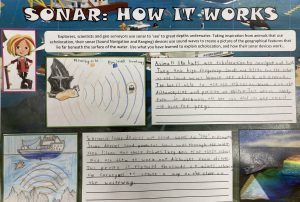 Pupils undertook a study of SONAR technology, beginning with a look at echolocation in animals. They learned all about how bats use sound to ‘see’ their surroundings. Through this, they garnered an understanding of the process of emitting sound waves and analysing their echoes in order to understand both locational and directional data. Pupils then explored the ways in which scientists, technicians and geo surveyors have employed this concept in their SONAR technology. Using the Get Kids into Survey exploration poster resources, they explored a busy offshore scene, where the hydrography technology they had studied was being put to use in a range of scenarios. They learned how boats use SONAR to map underwater features, and in this case, how that technology could be used to unlock the secrets lurking beneath Loch Ness. It became clear that plenty of scans and explorations had taken place on the lake, some claiming to disprove the existence of Nessie through lack of findings; others claiming to have either spotted the creature itself, or found lairs where the monster might easily hide. In 2018, we discovered, scientists embarked on an eDNA analysis of the loch, and found a considerable presence of eel DNA – sparking the idea that an as-yet unidentified species of giant eel might live in Loch Ness. It was beginning to look like geo tech might be the best source of concrete information!
ART
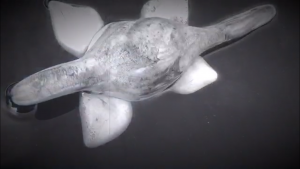 Having looked into the ‘evidence’ behind the mystery of the Loch Ness Monster, we decided to have some fun with the hoaxes! The notorious ‘Surgeon’s Photograph’ from 1934 endured for sixty years before being revealed as a fake; a cardboard and plasticine model attached to a toy submarine. In that spirit, pupils used modelling clay to create the classic shape of the creature, then painted their models a grainy grey. After that, they took their replica monsters to a Reception class water tray and, employing some trick photography on tablet devices, captured images that would give the Surgeon’s Photograph a run for its money!
THE GRAND FINALE
At the end of the week, the group revisited the question that started it all: do you think the Loch Ness Monster could really exist? What began as a resounding ‘no’ had turned into a tentative ‘maybe’, as a result of all the analysis, stories, technological studies and geological exploration. So, we decided to imagine that the monster was real for the afternoon! Each pupil was given a character, and wrote a script in-role that would form part of a news broadcast, detailing their encounter with the monster. In no time at all, news anchor Gabby Bigmouth and field reporter Harry Scoop were ready to report the sightings of Frankie McDougal (SCUBA gear factory owner), Captain Scans (SONAR boat captain), and Geoff Dairy (milkman), as well as the scientific findings of Dr Knowsalot!
The group enjoyed this cross-curricular project immensely, and learned a great deal about the application of practical geography skills and geo tech in exploring the world in all its intriguing wonder. As a result, they spent time studying the other Get Kids into Survey exploration posters, including the city scenes, forestry and mining, and the CSI poster – with its own mystery that they loved to solve! This project demonstrated the importance of engagement and excitement when it comes to making complex ideas accessible and interesting to younger children – something that the Get Kids into Survey initiative works hard to achieve with all its resources and activities.
Report compiled by Mathew Sullivan, FRSA
Class Teacher, Author and Educational Consultant
Why not try this project with your kids? Click here for full Lesson Plan