

Please fill out the form below to access our Translation Options Hotsheet:
Surveying Monopoly has been created with one big vision: to bring the world of geospatial surveying into a household game that families around the world can play, enjoy and learn from together. Across the board, real surveying and geospatial organisations are represented by their own unique characters, places and technology, showcasing just how varied and exciting the profession can be.
But who are the characters taking their places on the board, and what do they tell us about the real world of surveying? It’s time to meet them! Through a quick-fire Q&A, we’ll discover the inspiration behind each character, their favourite surveying tools, what their organisation does, and even where in the world they’d most like to survey.
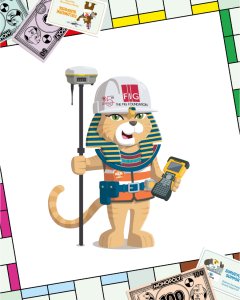
Let’s learn some more about The FIG Foundation‘s character Sphinx:
 Company name and location?
The FIG Foundation is an independent body under the International Federation of Surveyors (FIG), based in Copenhagen, Denmark. We are a non-profit organization focused on advancing the surveying/geospatial profession through support of research, grants, technical papers, and supporting young surveyors worldwide.
What is your name and what inspired your design?
Our character is a Sphinx. The Sphinx represents knowledge, mastery, and the ancient connection of surveying to geodesy and measurement, drawing a link back to the Egyptian rope-stretchers, the earliest surveyors (in hieroglyphics they were generally referred to as Scribes of the Fields).
What tool would you never leave the office or field without?
Your mind. Technology, procedures, and processes come and go. But the greatest of surveyors are problem solvers which is developed through mentorship, education, and experience.
Which square on the surveying Monopoly board would your character most like to visit and why?
I would visit GALAXY WAY and AI JUNCTION. These are the FIG Foundation’s properties, and they represent the Future of Surveying! We love these squares because The FIG Foundation is focused on funding young surveyors and educational projects globally to build that future. GALAXY WAY is all about looking to the stars and using satellites to measure our world, and AI JUNCTION is where new technology like smart robots and computers help us map and build.
What is the coolest thing about surveying that kids might not know?
A surveyor was there first! Before an ambulance, police officer, firefighter, mail carrier, or anyone else can find you, the land must be legally defined and mapped by a surveyor. Once the land is surveyed and subdivided, civil engineers and city planners can map out roads and streets. Surveying is about creating trust. Surveyors are the stewards of truth who ensure that property lines, maps, and buildings are fair and accurate, which is essential for safeguarding public trust and helping to plan communities. The first principle of surveying is honesty; providing accurate precise information. Surveyors do not make up figures; they record exactly what they survey.
How does your Foundation help surveyors measure, map, or build the world around us?
The FIG Foundation empowers the next generation of surveyors. We don’t measure directly; instead, we provide grants, scholarships, and support for educational and capacity-building projects, especially in developing countries. This ensures that young surveyors have the knowledge and tools needed to build a sustainable future. Since 2002, we have awarded over 315 grants to recipients in 86 countries.
If you could travel anywhere in the world to survey, where would you go?
I would travel to Africa. The FIG Foundation has a deep connection and high impact there, over the past 25 years having awarded 37% of all our grants to recipients in Africa to support the next generation of surveying leaders in that region. In addition to Africa, I would travel to the borders between countries and survey the international boundaries, record them so as to help achieve the United Nations’ Sustainable Development Goal 16 (SDG 16): to “Promote peaceful and inclusive societies for sustainable development, provide access to justice for all, and build effective, accountable and inclusive institutions at all levels.”