

Please fill out the form below to access our Translation Options Hotsheet:
Children Can’t Aspire to Careers They’ve Never Seen: Part One
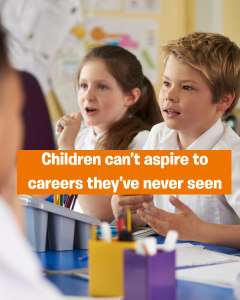 Ask a group of children what they want to be when they grow up and you will probably hear some familiar answers.
A doctor. A teacher. A footballer. A police officer. A YouTuber.
These are not bad aspirations, they are visible ones. They’re careers children see at home, at school, in their communities and through the media. But what about the thousands of other roles quietly shaping the world around them?
Research suggests that by the age of seven, most kids have started developing a narrow idea about the jobs that are “for them”. Those ideas are influenced less by the full range of opportunities available and more by the relatively small number of careers they regularly encounter.
Does that make us stop and think? Children do not choose from every possible career. They choose from the careers they know.
Visibility Shapes Aspiration
Imagine asking a child to choose their favourite flavour of ice cream after only ever tasting vanilla. They might genuinely believe vanilla is their favourite but have they really had a choice? Careers work in much the same way.
Children won’t be able to imagine themselves in roles they have never seen or heard about. Every day, they encounter teachers, nurses, firefighters and shopkeepers. They watch footballers on television, follow content creators online and see police officers in their communities. These careers feel real because they are visible and many others are not.
A reported 68% of adults in one Education and Employers study said they did not know their current job existed when they were at school. That figure shows just how many careers remain hidden during the years when children first begin forming ideas about their futures.
It is not only children who are unaware of these roles. Parents, carers and teachers may never have encountered them either. If the adults supporting children do not know that a career exists, it becomes much harder for them to introduce it, explain it or recognise the interests that might lead towards it.
As Andreas Schleicher, the OECD’s Director for Education and Skills, has said, children need to be aware of the world and the opportunities it offers them.
Awareness alone, however, isn’t the finish line. Careers become truly meaningful when a child can picture themselves doing them and when they stop thinking, “That’s somebody else’s job,” and begin thinking, “Maybe I could do that.”
The Hidden Careers That Build Our World
Behind every school, hospital, football stadium and new housing development are hundreds of professionals whose work most children never see. One of those professions quietly connects them all: surveying.
Before a building, road or community can be designed, someone first needs to measure, map and understand the land. Every school a child attends, every hospital they visit, every football stadium they cheer in and every new community they call home all began with that process. A surveyor was there first.
Yet ask a group of children what a surveyor does and most simply won’t know. Not because surveying is unimportant, but because they’ve never been shown the role it plays in shaping the world around them.
Surveying is far from the only profession that remains hidden from view. Environmental scientists monitor the ecosystems where children live and play. Urban planners shape safer neighbourhoods and future communities. GIS specialists use location data to support decisions about transport, healthcare and emergency response, while hydrographers map rivers, coastlines and the seabed. Drone pilots inspect infrastructure and gather information in places that would otherwise be difficult, expensive or dangerous to reach.
This Is Bigger Than Surveying
This conversation isn’t really about surveying, it’s about opportunity. When children only encounter a narrow range of careers, they don’t just miss out on discovering individual professions. They may never discover interests and strengths that could have led them towards work they genuinely love. A child who loves maps may never realise they would thrive in surveying. A fascination with rivers might never become hydrology. An interest in wildlife may never lead to ecology or conservation. The connection is never made because the career remains invisible.
That matters for children first, but the impact reaches much further. Many sectors are already facing skills shortages and need the next generation of engineers, scientists, planners, surveyors, geospatial professionals, ecologists, technicians and designers.
Yet this isn’t simply about filling vacancies. It’s about making sure every child has the opportunity to discover work that genuinely matches their interests, talents and curiosity.
No one is suggesting that primary school children should decide what they want to do for the rest of their lives. Childhood should be a time for exploring, changing interests and discovering new passions. But the wider the range of careers children encounter during those formative years, the more possibilities they have to imagine for themselves in the future.
Research from Education and Employers found that fewer than one percent of children said they had heard about the career they eventually drew from a volunteer visiting their school. At the same time, long-term studies suggest that the aspirations children develop during childhood and adolescence can influence later educational and employment outcomes. Together, those findings reinforce a simple but important idea: children don’t need to make career decisions early, but they do need the chance to discover what’s possible.
Making the Menu Bigger
The answer isn’t to tell children what they should become. It’s to help them discover what is possible.
That begins by introducing children to people and professions they may never otherwise encounter, revealing the hidden work behind the buildings, technology, transport systems and communities they use every day. It also means helping the adults around them discover those careers too, because parents, carers and teachers can only introduce opportunities they know exist themselves.
The more careers children encounter, the broader their understanding of the world becomes. Meeting people from different industries can challenge stereotypes about who belongs in particular professions, widen aspirations and help children imagine futures they may never have considered before.
Ultimately, success isn’t measured by how many children become surveyors, engineers or scientists. It’s measured by whether every child has had the opportunity to make an informed choice about their future. Whether they go on to work in surveying, medicine, teaching or a career none of us has even heard of yet matters far less than knowing those possibilities were there in the first place.
Helping Children See More
Broadening children’s awareness of careers doesn’t require every primary school lesson to become a careers lesson. In many cases, it can begin with something much simpler: helping children connect what they are already learning with the people who do it every day.
A geography lesson can become a conversation about surveying. A science topic might introduce environmental scientists or hydrologists. Designing a new community can open the door to planners, engineers and architects. Even an ordinary walk can prompt questions about who designed a bridge, mapped a footpath or protected a local habitat.
Parents, teachers, employers and professional bodies all have a role to play. Sometimes that role is as simple as sharing a story, answering a question, visiting a classroom or helping children see the hidden professions behind the places and technology they encounter every day.
Every new career a child discovers makes their view of the world a little bigger, and every conversation opens another possibility.
At Get Kids Into Survey, we’re working with teachers, parents, volunteers and industry to make one hidden profession a little more visible. Every classroom resource, school visit, ambassador talk and learning project is designed with one simple aim: to help children discover a career they may never otherwise have encountered.
We can’t show every child every career. But we can make sure surveying is no longer one of the invisible ones.
Because children can’t aspire to careers they’ve never seen.
Next in this series…
Curiosity Comes Before Careers
If visibility helps children discover careers, what helps them discover the interests that lead towards them?
In Part Two, we’ll explore why memorable projects, engaging stories and real-world experiences often inspire children long before job titles ever do.
References
-
Education and Employers — Starting Early: Building the Foundations for Success
https://www.educationandemployers.org/research/startingearly/ -
Wellcome — The Role of Informal Science in Youth Work: Findings from Curiosity Round One
https://wellcome.org/insights/reports/role-informal-science-youth-work-findings-curiosity-round-one -
NUSTEM — Children’s Early Career Choices
https://nustem.uk/blog/news/childrens-early-career-choices/ -
NUSTEM — 5 Year Impact Study: Primary Schools
https://nustem.uk/about/research/impactstudyprimary/ -
Alexandre, Xu, Washington-Nortey and Chen (2022) — Informal STEM Learning for Young Children: A Systematic Literature Review
https://pmc.ncbi.nlm.nih.gov/articles/PMC9320717/ -
Caspi et al. (2023) — STEM-Oriented Primary School Children: Participation in Year-Long STEM Programmes
https://www.tandfonline.com/doi/full/10.1080/09500693.2023.2177977 -
Kitchen, Sonnert and Sadler (2021) — Informal Learning Environments and Impact on Interest in STEM Careers
https://scholars.uky.edu/en/publications/informal-learning-environments-and-impact-on-interest-in-stem-car/ -
Zhang and Ma (2023) — A Study of the Impact of Project-Based Learning on Student Learning Effects: A Meta-Analysis Study
https://pmc.ncbi.nlm.nih.gov/articles/PMC10411581/ -
Edutopia — Boosting Student Engagement Through Project-Based Learning
https://www.edutopia.org/article/boosting-student-engagement-through-project-based-learning/