
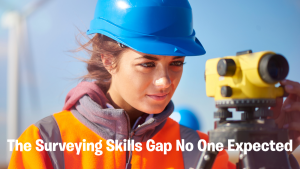
 For years, we’ve been talking about the same challenge in surveying: how do we get more young people into the profession? It’s the very reason Get Kids into Survey started back in 2017.
The reality is, surveying isn’t a career most young people grow up aiming for. Many who enter the profession have a personal connection – a parent, relative or family friend already in the industry. Others simply fall into it by accident. That lack of visibility is exactly what initiatives like Get Kids into Survey have been trying to change.
And while there’s more effort to shift that, progress still feels slow. For many firms, the same challenges remain: too few applicants, too little awareness and not enough young people actively choosing surveying.
The Big Shift
What’s coming next makes this even more significant. Because it’s not just about getting people into surveying anymore.
Recent research found that only 41% of Gen Z workers feel confident building professional relationships in the workplace. Suddenly this isn’t just a recruitment challenge, it’s a readiness challenge too.
And that’s a much harder problem to solve.
“We Can Teach the Tech. It’s Everything Else.”
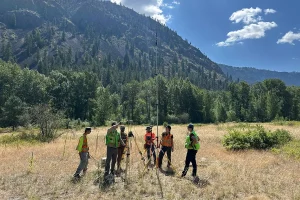
Spend time with any surveying firm and you’ll hear the same frustration:
“We can teach them the tech. It’s everything else that’s the challenge.”
Employers aren’t struggling to teach someone how to use equipment, process data or pick up new software. Those things, while technical, are structured, trainable and repeatable.
What’s harder, and far less predictable, is everything that sits around it.
– How someone communicates
– How they ask questions
– How they handle pressure or uncertainty
– How they interact with clients, colleagues and people on site
These are the skills that shape day-to-day performance and increasingly, they’re the ones employers feel are missing.
Surveys back this up. Communication, teamwork and problem solving are now ranked above technical ability as the most important skills for early-career workers. These ‘soft skills’ aren’t soft at all, they’re foundational and that’s becoming harder to ignore.
Yet they’re also the hardest to teach once someone is already in the job.
By the time someone walks through the door as a new hire, a lot of this is already set. How they communicate, how they handle pressure, how they read a situation, these patterns have been developing for years and are often deeply ingrained. They’re not impossible to change, but they’re not quick fixes either.
A New Kind of Communication Gap
This isn’t about people lacking ability. It’s about how skills such as communication, confidence and empathy are developing differently. In many ways this feels like a translation gap between two worlds.
Young people often communicate comfortably and authentically online, but those habits don’t always translate smoothly into workplaces that still rely heavily on phone calls, meetings, hierarchy and face-to-face interaction. Messaging, voice notes and short-form interactions are second nature. But workplaces still depend on in-the moment conversations, explaining ideas in real time and responding to situations as they unfold.
That’s where the gap starts to show.
Communication isn’t just about speaking. It’s about reading tone, recognising discomfort, understanding pressure and adapting how you respond depending on the person in front of you. This is where empathy is built. And that’s not something you learn from a screen.
It doesn’t come from perfectly edited messages or curated online interaction, but through real-world experiences, awkward conversations, mixed age environments and learning how to navigate people face-to-face.
Despite being constantly connected, only a minority of young workers say they feel confident building professional relationships. Honestly, that’s pretty wild! Communication isn’t missing, it’s just developing differently.
And to be clear, this isn’t true for every young person. Research suggests the issue is more nuanced than “screens = no social skills”. But what does seem clear is that heavy digital communication and reduced face-to-face interaction can crowd out some of the experiences where empathy and confidence are normally built.
Why Surveying Feels It First
Despite all the technology, surveying is still a people business. Surveyors spend their days with clients, contractors, landowners and colleagues, often explaining complex issues and navigating conversations where people may be under pressure, frustrated or uncertain.
The technical side can usually be taught relatively quickly. Software can be learned. Processes can be followed. But the human side takes longer.
It requires something deeper than technical competence – the ability to read a situation, understand concerns and communicate in a way that reassures people, not just informs them.
And in surveying, that skill becomes visible very quickly.
When confidence isn’t there, projects can slow down, misunderstandings increase and trust becomes harder to build. Not because the technical work is wrong, but because the communication around it is missing.
And this is where the industry may be overlooking something important.
Empathy isn’t a soft skill. It’s a professional skill. A commercial skill. A trust-building skill.
It’s what allows someone to read the room, understand concerns, adjust their communication and keep situations moving forward productively. It helps people feel heard, reassured and confident in the person standing in front of them.
Because in reality, clients rarely judge surveyors on technical accuracy alone. They also judge them on clarity, confidence, professionalism and how they make people feel during the process.
When that human element is missing, even technically correct work can create friction, confusion and mistrust. But when it’s present, it strengthens relationships, improves collaboration and builds confidence in both the individual and the profession itself.
That’s why the industry notices the gap early.
Surveying depends on technical accuracy.
But it also depends on people feeling confident in the person delivering it.
Where These Skills Really Begin
This is where the conversation becomes bigger than the industry.
Because these skills don’t start at work, they begin much earlier. Long before someone walks onto a site for the first time.
In classrooms. Around dinner tables. In part-time jobs. In team sports. In awkward social situations. In moments where young people learn how to speak up, handle disagreement, build confidence and understand other people.
For teachers and parents, this will feel familiar. These are the same skills being developed through group work, presentations and real-world learning. And the more opportunities young people have to practise them early, the more confident they become later.
Then add in the pandemic into the middle of key developmental years and it starts to make a lot more sense why employers are noticing a difference. Many young people didn’t just miss lessons during COVID.
They missed years of rehearsal.
Rehearsal for communication, teamwork, confidence, conflict, presentation, collaboration and even face-to-face interaction. Real life became something many young people simply had less opportunity to practise.
Jonathan Haidt, author of The Anxious Generation, argues that these social experiences are far more important than we often realise:
“Attunement (deeply present) forms the foundations for later emotional self-regulation. Children who are deprived of this joyful, mutually trusting social experience often face emotional difficulties and exhibit erratic behaviour in their later years.”
While Haidt is discussing child development more broadly, the point is relevant. The ability to navigate relationships, communicate effectively and handle challenging situations doesn’t suddenly appear in adulthood. It is built gradually through repeated social experiences over many years.
So What Can We Do?
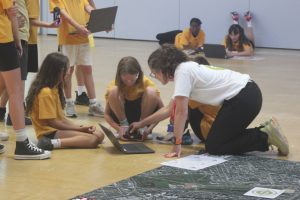 The good news is, this isn’t a fixed problem.
Confidence, communication and workplace skills can all be developed. But they need opportunities to be practised.
That can happen through programmes such as Design Engineer Construct (DEC) from Class of Your Own, geospatial outreach initiatives like Geoconnected, school projects, sports teams, part-time jobs, work experience placements and mentoring opportunities.
We’re already starting to see education evolve in this direction. At Geo Business 2026, one example discussed on the Main Stage was the Bloxham Sustainability Challenge, which encourages sixth form students to tackle real-world sustainability problems through teamwork, research and problem solving. Unlike many traditional qualifications that focus primarily on subject knowledge and exam performance, the challenge places equal value on the broader skills that employers consistently say they need.
The programme has recently been awarded UCAS points, worth up to half an A-Level recognising that communication, collaboration and critical thinking are just as important as academic achievement.
As one student, Matilda Bonnington explained:
“There’s a push for getting the best grades but not for being personable or confident. This experience has helped to give me the skills needed to aid me with those real-life experiences that I’ll have to encounter.”
In many ways that is what employers are asking for more of: Rehearsal for real life.
It’s a powerful reminder that preparing young people for the future isn’t just about knowledge. It’s about giving them opportunities to apply that knowledge, work with others and engage with real-world challenges.
It also requires industry to play its part. More companies opening their doors for work experience, shadowing opportunities and careers events would give young people valuable exposure to professional environments long before they apply for their first role.
Initiatives such as Get Kids into Survey, Geoconnected and many others are helping raise awareness of geospatial careers, but awareness alone isn’t enough. Young people need opportunities to build confidence, communication skills and real-world experience alongside technical knowledge.
The earlier those opportunities begin, the stronger those foundations become.
Looking Ahead
This isn’t just about one generation. In many ways we’re only at the beginning of this shift.
The next generation growing up now, often referred to as Gen Alpha – is being raised in an even more digital first world. They’ll arrive with incredible strengths, especially around technology and adaptability, but likely even less exposure to the kind of face-to-face, mixed age interaction that builds confidence, empathy and real-world communication.
Which means this isn’t a short-term challenge. It’s the direction things are heading. And if Gen Z is the first generation exposing this shift in the workplace, Gen Alpha may be the generation that forces us to finally address it.
Final Thought
The conversation around surveying has long focused on attracting more young people into the profession.
That’s still important.
But perhaps the bigger opportunity is helping young people develop the confidence, communication skills and real-world experience they’ll need when they arrive.
Awareness opens the door.
Readiness helps them walk through it.
And building both starts much earlier than we think.
Sources and Further Reading:
Deloitte Global Gen Z and Millennial Survey 2025
https://www.deloitte.com/ce/en/issues/work/genz-millennial-survey.html
Haidt, J (2024). The Anxious Generation: How the Great Rewiring of Childhood is Causing an Epidemic of Mental Illness. Penguin Press.
https://www.anxiousgeneration.com/book
National Association of Colleges and Employers (NACE) – Career Readiness Competencies
https://www.naceweb.org/career-readiness/competencies/
World Economic Forum – Future of Jobs Report
https://www.weforum.org/reports/the-future-of-jobs-report-2025/
McKinsey & Company – Defining the Skills Citizens Will Need in the Future of Work
https://www.mckinsey.com/featured-insights/future-of-work/defining-the-skills-citizens-will-need-in-the-future-world-of-work
OECD – Education and Skills Outlook
https://www.oecd.org/education/education-and-skills-outlook/
Uhls, Y. T. et al. (2014) – Five days at outdoor education camp without screens improves preteen skills with nonverbal emotion cues
https://www.sciencedirect.com/science/article/pii/S0747563214003227
Children & Nature Network – Research on screen time and emotional cue recognition
https://research.childrenandnature.org/research/screen-time-significantly-impacts-adolescents-ability-to-assess-face-to-face-nonverbal-social-and-emotional-cues-2/
UNICEF – Adolescent Mental Health and Wellbeing
https://www.unicef.org/mental-health
World Health Organization (WHO) – Adolescent Mental Health
https://www.who.int/news-room/fact-sheets/detail/adolescent-mental-health
Bloxham Sustainability Challenge https://www.bloxhamschool.com/bloxham-sustainability-challenge/
Photo Credits –
Image 2: NSPS Young Surveyors Network & WA Young Surveyors Network
Image 4: Kate Bartels, Geoconnected