


 If you have a character; how did you choose and what does he/ she/ thing represent? Mean to you? – One of the most important projects that we have ever run is the Bridging Kentucky Program… Our bridge surveys are helping sustain safe bridges for school busses, firetrucks, and emergency workers to cross Kentucky Bridges. The
 Company Name – Position Partners
 Company Name: She Maps
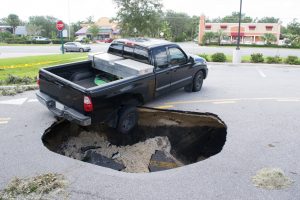 At the start of a series of lessons, the pupils were shown an above-ground image of a large hole in the middle of a street. They were challenged to adopt the persona of a member of the public, and describe what they came across as they approached the scene – paying particular attention to the most hazardous elements…
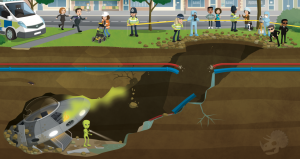 Having set the scene, pupils were given a sneak peek at what lay beyond the entrance to the crater,
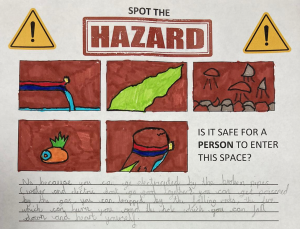 The group managed to identify five separate hazards that might make the crash site a no-go area for the investigators. They noticed that the broken utility pipes posed a problem – especially with the potentially catastrophic combination of electricity and water. They noted that the strange green smoke floating up through the cavity might well be toxic, and that where there is smoke, there is likely fire – just like the one on the alien’s ship! The group also identified the crumbling rocks as a hazard; one that could crush an investigator or cause a cave-in that would trap them underground. Finally, they identified the crater itself as a fairly hefty fall risk! All in all, the group agreed that it would not be safe for a person to enter the space… So how would the investigators ever find out what was down there?
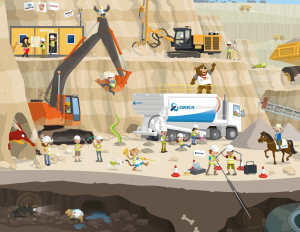 Using the Get Kids into Survey Mining Exploration Poster, pupils explored the technology that surveyors use to investigate and map cavities, caves, rocky areas and hard-to-reach places. They learned about LiDAR technology: devices that emit light rays and measure reflections to create a 3D image of a given space. They also discovered that these scanning devices can be mounted to a variety of vehicles, turning them into mobile mapping systems. The pupils noticed that, in the poster, there were three mobile mapping systems: one where the LiDAR scanner was mounted to a robotic vehicle; one where a scanning device was fixed to a drone, and one where a
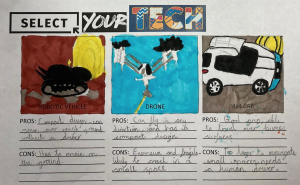 LiDAR unit was mounted to a 4X4 vehicle. The pupils were asked to generate pros and cons for each of these systems in the context of exploring the underground tunnel from the street scene.
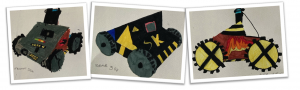
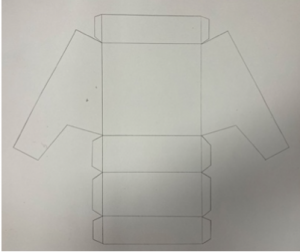
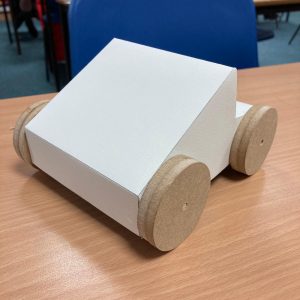
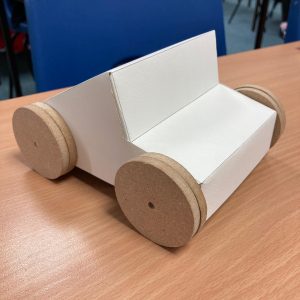
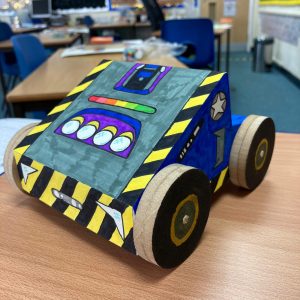
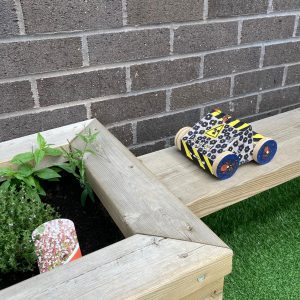 The result of the groups’ creative efforts was a set of prototype vehicles that looked like they could take on any survey situation, no matter how out-of-this-world it was! The children even took their models outdoors to put them through their real-world paces…
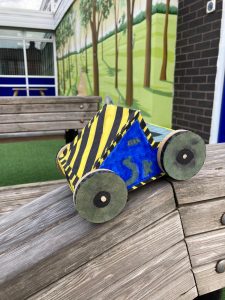 To round-off the project, the group used their drama skills to enact the discovery of the alien ship, and the reactions of the various people in the original scene. The pupils enjoyed the Shared-Space Invaders project immensely, and through the imaginative Get Kids into Survey stimuli, and a creative, cross-curricular teaching approach, they learned a great deal about cutting-edge professional technology, hazard safety, and the fascinating world of underground survey.
 Company Name UPG
 Company Name: RIEGL
 How did you get into the Industry? One summer I was playing catching fish in a mountain stream in southern Austria, when a drone flew up in the air nearby. Of course that captured my interest! I’d never seen one like this before. It seemed to be carrying a package, and it was going back and forth in a pattern.
 Company Name Geoscience Australia is Australia’s public sector organisation responsible for geology and geography. Positioning Australia is one of GeoscienceAustralia priority programs.
 What is your character and why did you choose it? Our character is a Tasmanian Devil. This is a uniquely Australian animal found only on the Australian Island of Tasmania. The Devil is currently under threat due to a genetic disease. By providing access to an accurate and reliable positioning capability, researchers will be able to better track the movements of these amazing creatures to understand their behaviours and help keep the remaining populations safe for generations to come.

Please fill out the form below to access our Translation Options Hotsheet:
In the final week of what has been an out-of-the-ordinary academic year, a group of key worker children set out to solve a fittingly out-of-the-ordinary mystery: the baffling demise of the abominable snowman. They were asked to take on the role of CSI – Crime Scene Investigators – to collect, collate and analyse a range of evidence, biological samples and eyewitness accounts, linking them together in order to discover the true culprit behind the tragic departure of the giant yeti…
Introducing the Project
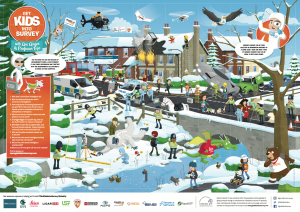
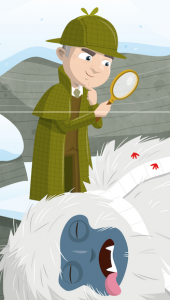 The group started with the Get Kids into Survey CSI Exploration Poster and, with the help of the prompt questions, quickly identified the number one suspect.
They spotted the red footprints and the telling toilet roll – following both across the village green, over the bridge, up the tree to find…
 All signs seemed to point towards this mince pie stealing, toilet roll touting, red-pawed menace. That was, until the class was read the transcript of a phone call to the emergency services that came just moments after the yeti met his end – a call that cast a sudden and murky shadow of doubt on the murderous squirrel theory…
Reviewing the Case
The frantic call included tales of some odd goings on occurring ‘down by the lake’. The caller reported that a huddle of suspicious characters seemed to planning something, even though, by her own admission, the members of the gang couldn’t actually talk. Luckily, she was able to provide some general visual descriptions, which the group used to search the scene for possible culprits. It wasn’t long before they found some unusual suspects…
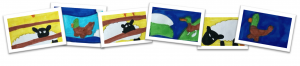
A HOT TIP
Having identified the group of shifty-looking animals as ones-to-watch, the group received photographic evidence collected from the burnt-out house, not far from where the yeti was found. This brought to light some interesting new information, and made clear the importance of a CSI’s work, their methods, and how they help in solving crimes. The group linked their previous learning on LiDAR and measuring technology to the work of CSIs, noting that a lot of the survey techniques with which they were already familiar were being used at the crime scene. For example, there was a GPR scanner being used to ‘look’ for anything suspicious below ground, and there were LiDAR scanners collecting digital image data to facilitate the creation of a virtual crime scene. There was also some good old fashioned photography going on, and the pictures taken inside the house where the fire had occurred were of particular interest to the pupils…
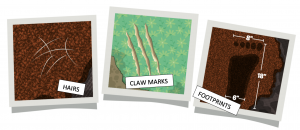
Whilst the hairs might have been put down to the family dog – and the claw marks too (although they looked too wide and too deep to belong to Bingo the friendly beagle), the size of those footprints pointed towards one very distinct owner. However, it wasn’t enough for the pupils to assume that they belonged to the yeti; putting him at the scene of the house fire was a big step to take – pun intended! They had to know for sure that these footprints belonged to something abominable. It was time for a crime scene recreation!
First, the pupils took the dimensions from the footprint and created their own replicas:
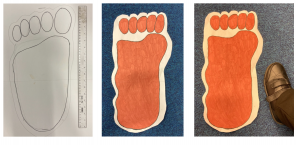
Then, using the stride measurements taken by the CSI team (80 inches between each print), the group recreated the path taken by the owner of the footprints through the house:
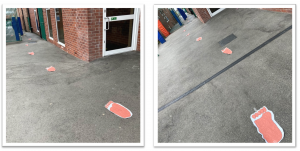
Once the footprints had been laid at carefully measured intervals, the group took turns to try and cover one of the single steps with their own feet. Whilst some pupils almost ended up doing the splits, and a few members of staff also tried their best, no-one was able to match the stride length of the owner of the footprints. A second challenge saw the pupils taking leaping bounds along the footprint path to see how many of their steps it would take to cover the same distance that the footprint owner covered in eight. Even with their best, bounciest efforts, the lowest any pupil managed was thirteen steps. These endeavours confirmed the group’s suspicions: there was only one character in the scene tall enough to leave footprints like that… the yeti himself. And if those footprints were followed, the pupils noted that they led back to the burning house – putting the yeti at the scene of a possible arson attack!
Collect the Evidence
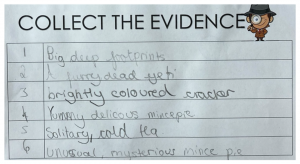 With the shocking revelation that the yeti must have been in the house where the fire was before the blaze got completely out of control, the group was compelled to examine the epicentre of the crime scene once more. They focused on the yellow numbered markers dotted around the yeti, and they learned that these are used in the collection and collation of evidence. They help CSIs and police to keep track of individual pieces of evidence, and in this scene, there were six key items. The group described each one in their notes, and began to think about what they could mean in light of the latest information from the CSI team. The Christmas cracker became a particular item of interest, especially after it was revealed to have contained an expensive gift…
Social Media Shocker
While re-examining the crime scene, the group noticed the two shady agents across the road, both of whom were looking very concerned. It seemed that they had been making their own inquiries, and had turned up some very interesting evidence from their analysis of the villagers’ social media pages…
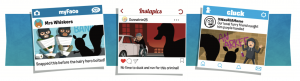
The pupils recognised those shadowy silhouettes immediately: the animals from their suspect sheet! It was beginning to look like this village had its own squad of furry vigilantes, who tracked down criminals and brought them to justice. But if the ducks, the sheep, and that sneaky squirrel were the good guys, what did that make the yeti?
It was time for a final review of the evidence…
- Large footprints, claw marks and hair put the yeti at the scene of the house fire before the blaze. One Christmas cracker containing a precious gift was reported missing from the house.
- CSI found toilet paper at the scene, matching the brand used by the mysterious vigilante whocaught the bank robbers.
- A series of extremely large footprints were found crossing the river bank, heading away fromthe house where the fire was and leading to where the yeti was found. This suggests that theyeti was running from the house when he met his demise.
- A group of unsuspecting animals seem to have become a team of crime-fighting vigilantes,using baked goods as bait, and toilet roll as a weapon.Finally, the pupils were asked to prepare their conclusions:The yeti was trying to steal the Christmas cracker from the house. He was the criminal because he also started a fire. The animal suspects were actually the heroes of the day, luring him and capturing him. They set a trap with mince pie and toilet paper (the toilet paper was their weapon). I was really shocked but it makes perfect sense. The reason why the yeti ran and cut through the fence was because he could smell the mince pie, but he was also trying to escape the house before he was burnt like he’d been put in the oven. I can tell it was the yeti, because nothing else could have left footprints that big! The animal suspects were acting very sneaky so they could plan the things they needed to do to stop the yeti once and for all. I think that the yeti was an arsonist because he was in the house before the fire happened, so he must have caused it. This criminal has thankfully been stopped. The social media pages make the animal suspects the heroes.– Year 4 Pupil, aged 9The group thoroughly enjoyed the Get Kids into Survey CSI learning project; they were excited by its mix of intrigue and workable clues – they felt very smart to have cracked the case by the end! The project also enhanced both their knowledge and perception of survey techniques. The fact that these methods and technologies have applications beyond mapping, architecture and physical geography made the world of geo survey even more interesting!