

Exploring Mining: The Hidden Story Behind the Things We Use Every Day

What does mining have to do with your phone? More than you might think…

Mining might not be the first topic that comes to mind when you’re looking for something new to teach children, but that’s exactly why it works so well.

From the phones in our pockets to the roads we travel on, mining is quietly behind so much of modern life. Yet most children never stop to think about where these materials come from, how they’re discovered, or the people and technology involved in bringing them to the surface.

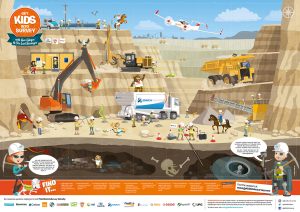
That’s where our Mining Poster comes in.

Designed to be colourful, engaging and packed with discovery, it invites children to explore how we find, measure and extract the materials that shape our world. Along the way, they’ll discover the role surveyors play in mapping mines, measuring underground spaces and helping projects operate safely and efficiently.

Whether you’re a parent looking for a fresh home-learning topic, a home educator planning a project, or a teacher searching for a real-world STEM resource, the Mining Poster offers countless opportunities to spark curiosity.

Why Children Find Mining So Fascinating

Mining naturally leads to some brilliant questions:

  •     How do people know where valuable minerals are underground?
  •     What does a mine actually look like beneath the surface?
  •     How do engineers and surveyors create maps underground?
  •     How do mining companies keep people safe?
  •     What materials in my house came from a mine?

These are the kinds of questions that encourage children to investigate, research and think critically about the world around them.

And often, one question leads to another.

Before long, a conversation about a mobile phone can become a lesson in geology, geography, maths, engineering, technology or environmental science.


Did You Know?

Did you know that many of the items you use every day contain materials that were once mined from the Earth?

Take a look around the room.

📱 Your phone
💻 Your laptop
🚲 Your bicycle
🏠 Your home
🔋 Your batteries

Mining isn’t something that happens somewhere else. It’s connected to almost everything around us.

That’s just one of the many discussion points explored in our accompanying Mining Q&A sheet, which is packed with questions designed to get children thinking, investigating and asking “why?”

One Question Leads to Another

One of the best things about teaching children through real-world topics is that learning rarely stops with the first question.

A conversation about mining might begin with:

“Where does the metal in my phone come from?”

Before long, children are exploring geology, discovering how minerals form over millions of years, learning how surveyors use drones, GPS and laser scanners to map the land, and discussing how mining companies work to protect wildlife, restore landscapes and source the materials needed for renewable energy. Modern life depends on mined materials, from smartphones and bicycles to wind turbines and electric vehicles, making mining an ideal starting point for exploring science, technology and sustainability.

That’s the beauty of curiosity.

One question becomes another.

Children begin making connections between subjects they might normally learn separately, discovering that geography, science, engineering, environmental studies and surveying all work together to solve real-world problems.

The Mining Poster isn’t designed to teach children everything there is to know about mining.

It’s designed to spark a conversation.

Because sometimes, one simple question is all it takes to inspire a lifetime of curiosity.


A Great Resource for Teachers, Parents and Home Educators

One of the things we love most about the Mining Poster is how many different directions the learning can take.

For teachers, it can support lessons in geography, STEM, natural resources, sustainability and careers.

For parents, it can spark conversations about how the modern world works and encourage children to look more closely at the objects they use every day.

For home educators, it can become the starting point for a wider project covering:

  •     Earth’s natural resources
  •     Mapping and geography
  •     Engineering and technology
  •     Sustainability and environmental responsibility
  •     Future careers and workplace skills

Rather than simply presenting facts, the poster encourages children to ask questions, investigate answers and make connections between subjects.

Where Does Surveying Fit In?

Before a mine can be built, expanded or monitored, someone needs to understand exactly what is happening above and below the ground.

That’s where surveyors come in.

Mining surveyors use a range of technologies to measure, map and monitor mining sites. Depending on the project, they may use GPS equipment, total stations, laser scanners, drones and specialist software to capture highly accurate data.

Some tools help surveyors map large areas of land, while others create detailed 3D models of tunnels, underground workings and mining infrastructure.

Laser scanners, for example, can collect millions of measurement points in a matter of minutes, helping create digital replicas of mines that can be explored and analysed on a computer. Drones can quickly survey large or difficult-to-access areas, while GPS technology helps ensure equipment, infrastructure and excavation work are positioned accurately.

These technologies help mining companies improve safety, monitor changes over time and make informed decisions about how a site is managed.

It’s a fascinating combination of technology, problem-solving and real-world application, and often surprises children who may not realise just how much innovation is involved in modern surveying.

Surveying in Action: When Accuracy Really Matters

The technology used in mining doesn’t just help companies work more efficiently. In some situations, it has helped save lives.

In 2010, 33 miners in Chile became trapped nearly 700 metres underground after a tunnel collapsed. For 69 days, the world watched and hoped. Engineers and surveyors relied on detailed measurements, mapping and precise drilling plans and measurements to locate the miners and guide rescue shafts with incredible accuracy. Remarkably, every miner was brought safely back to the surface.

A few years later, when a youth football team and their coach became trapped in a flooded cave system in Thailand, rescue teams again relied on detailed mapping, advanced 3D mapping tools, to better understand the underground environment and plan safe routes through the cave network.

These are dramatic examples, but they highlight something important: surveying isn’t just about collecting data. It’s about understanding places that can be difficult, dangerous or impossible to see with the naked eye.

Whether helping rescue teams navigate underground spaces or helping mining companies monitor changing conditions, surveyors provide the information that allows people to make safer decisions.

(At the end of the blog, you’ll find links to articles, videos and other sources to help you explore the topic in more depth.)

Did You Know?

Some laser scanners can capture millions of measurements in just a few minutes, creating highly detailed 3D models of mines and underground spaces.

That’s just one of the many technologies mining surveyors use to help keep operations safe and efficient.


Continue the Conversation

Why not ask your children:

  •     Which objects in your home might contain mined materials?
  •     What do you think happens before a mine is built?
  •     How would you create a map underground?
  •     What skills do you think people working in mining need?

You might be surprised by the answers.


Thank You to Our Sponsors

Like all Get Kids into Survey resources, the Mining Poster was only possible thanks to the support of organisations that believe in inspiring the next generation.

This poster was a truly international collaboration, bringing together supporters from the UK, USA and Australia who share a passion for education, outreach and raising awareness of surveying careers.

A huge thank you to:

3D Reshaper, Bowman Consulting, Carlson Software, GeoSLAM, Indiana Society of Professional Land Surveyors, Land Surveys, Laser Scanning Forum, Mini Map Makers, NEI, NSPS, Orica, Position Partners, SSOE Group, TopoDOT, RIEGL, UPG and Precise Observation Mining Solutions.

Their support has helped this resource reach classrooms, homes and outreach events around the world.

Continue the Adventure

If you’re ready to discover the hidden world beneath our feet, explore the Mining Poster online, download the accompanying Q&A sheet, or order a free printed poster from our shop (you’ll just need to cover the postage). We also have a homework project.

Who knows? One question about a mobile phone could lead to an adventure through geology, engineering, surveying and the incredible technology that helps us understand the world beneath our feet.


Further Reading:

Chile mine rescue (2010)

General overview (facts, dates, depth):
https://www.britannica.com/event/Chile-mine-rescue-of-2010


Drilling and rescue operation (“Rescue 33” story):
https://centerrock.com/about-us/job-stories/chilean-mine-rescue/


Rescue organisation reflection (10 years on):
https://www.mrsl.co.uk/about-us/knowledge-hub/rescue-33-chilean-miners-10-years


Thai cave rescue (2018)

Short piece on 3D scan of Tham Luang cave:
https://www.youtube.com/watch?v=Buda6f3n16g


Article about “The Rescue” documentary and 3D cave modelling:
https://www.documentary.org/column/rescue-recounts-2018-thailand-cave-mission


3D GIS visualisation of drilling options at Tham Luang:
https://mediaspace.esri.com/media/t/1_4h4d51u0


Modern mining surveying and safety tech

Surveying in the mining sector (laser scanning, drones, 3D models):
https://www.gim-international.com/content/article/surveying-in-the-mining-sector


Underground mine safety technologies in real-world scenarios:
https://www.identecsolutions.com/news/mining-safety-use-case-technologies-in-real-world-scenarios


Ambassador Spotlight ‘Ekpor Jephta’

Welcoming Ekpor Jephta our latest Brand Ambassadors covering Southern Nigeria, Rivers State, Bayelsa State, Akwa Ibom and Cross River State (Africa):

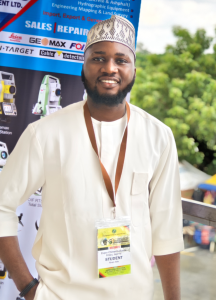
How did you get into surveying? My journey into the geospatial industry began with a curiosity about how maps help us understand and solve real-world problems. While studying Surveying and Geomatics, I discovered that geospatial technologies go far beyond mapping, they influence environmental management, disaster response, urban planning, infrastructure development, and community decision-making. What started as academic interest evolved into a mission to make geospatial knowledge accessible to more young people, particularly in underserved communities. Today, I combine GIS, GeoAI, technology, education, and community engagement to help others discover the opportunities within the profession.
What are your plans as a Brand Ambassador? My goal is to expand geospatial awareness among young people across Nigeria and Africa by introducing surveying and GIS to students long before they make career choices.

As a Get Kids Into Survey Ambassador, I plan to:

Organize school outreach visits and GIS Day activities.
Introduce students to surveying, mapping, GIS, drones, and Earth observation.
Partner with teachers and schools to integrate geospatial awareness into STEM education.
Distribute and promote Get Kids Into Survey educational resources.
Create engaging social media content highlighting geospatial careers.
Build connections between students, universities, and geospatial professionals.
Support the development of future surveyors and geospatial innovators throughout Africa.

Tell us a bit about what you do: I am a Surveyor, GIS Analyst, GeoAI Advocate, Creative Strategist, and youth development champion based in Nigeria.

I currently serve as Partnership Advisor for FIG Young Surveyors Network VCSP and have contributed to international geospatial initiatives including the 4th African Young Surveyors Meeting (Kenya) and the 10th FIG Young Surveyors Conference (South Africa, 2026).

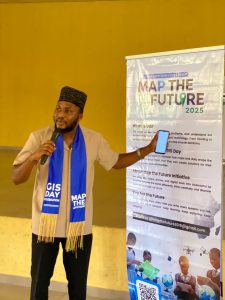
I founded Map the Future, a geospatial outreach initiative that introduces secondary school students to GIS, mapping, Earth observation, and spatial thinking. Since launching the initiative, I have worked with schools, students, and educators to increase awareness of geospatial careers and demonstrate how maps can solve challenges such as flooding, waste management, environmental degradation, and urban development.

Professionally, I work across GIS, spatial analysis, GeoAI, remote sensing, digital innovation, community engagement, and technology education. I am passionate about building the next generation of African geospatial leaders.

Anything else you’d like to add? One of my strongest beliefs is that many children never become surveyors simply because they are never exposed to the profession early enough. Through Map the Future, I have seen students become excited about mapping their schools, communities, and environments once they understand the impact of geospatial technologies.Before now I have visited more than 15 schools, and reached over 12,000 school children and made impact, But with Get kids into Survey, at map the future we will be able to do more.

Ambassador Spotlight ‘Feyisayo Sotayo’

Welcoming Feyisayo Sotayo from South-West Nigeria, Africa:

How did you get into surveying? It’s a course I studied in school and I am gradually developing into it especially after my registration as a surveyor

What are your plans as a Brand Ambassador? To propagate the gospel of the surveying profession to the younger generations and guide them on the steps to achieve it.

Tell us a bit about what you do: I am a registered surveyor from Nigeria, I have MSc surveying and geoinformatics and I belong to different associations and committees, I am on a mission to educate the younger generation through career talks and sensitization programs within my region and extend it across the globe.

Anything else you’d like to add? I would say surveying is not only for the man, anyone with the passion can do it and they can do better

Ambassador Spotlight ‘John Penfold’

Introducing John Penfold from the East Midlands, UK:

How did you get into surveying? I started as an analyst in the military, then grew my career in GIS and data science.

What are your plans as a Brand Ambassador? I just want to share my enjoyment of and experience with geospatial data, imagery, and data science with the next generation of nerds.

Tell us a bit about what you do: I provide geospatial data engineering and data science solutions for our clients, making use of both open and exquisite spatial data sources.


Ambassador Spotlight ‘Aleksandr Solopov’

Welcoming Aleksandr Solopov our Brand Ambassador from Middle East region, based in the UAE (with coverage across GCC countries including Saudi Arabia, Bahrain, Oman, Qatar and Kuwait). Let’s learn some more about him:

How did you get into surveying? I studied at Moscow State University of Geodesy and Cartography. After graduating, I worked for a couple of years as a land surveyor in civil engineering. In 2012, I joined Leica Geosystems, where I became part of the Reality Capture department, which marked the start of my deeper involvement in the geospatial industry.

What are your plans as a Brand Ambassador? As an ambassador, I aim to promote awareness and adoption of geospatial and reality capture technologies across the Middle East. I plan to share my knowledge and real-world experience through technical content, case studies, and my blog (unsurveyed.xyz). I also want to engage with the community by supporting users, highlighting best practices, and helping professionals better understand modern workflows and tools.

Tell us a bit about what you do: I work as a Sales and Technical Support Specialist in the geospatial industry, focusing on reality capture solutions. I support customers across the Middle East region with technologies such as laser scanning, mobile mapping, and point cloud processing—helping them choose the right tools, implement workflows, and succeed in their projects. In addition to my professional role, I run a blog (unsurveyed.xyz) where I share insights, practical tips, and real-world experiences related to geospatial technologies and reality capture.

Anything else you’d like to add? I recently released a browser-based reality capture game (https://www.unsurveyed.xyz/main-page/reality-capture-game) that introduces indoor laser scanning concepts in a fun, interactive way. It simulates real workflows like scan setup planning and registration accuracy, making it useful for both professionals and beginners, including students. It’s lightweight, runs directly in the browser, and is best experienced on a PC with mouse and keyboard.

Ambassador Spotlight ‘Paula Teperino’

Welcoming Brand Ambassador Paula Taperino who is covering the area of Uruguay with a focus on Spanish-speaking outreach across Latin America! Let’s learn some more about her:

How did you get into surveying? I got into the geospatial industry through my studies in Cartography and my interest in maps, spatial data, and technology. During my early professional experience, I worked with field surveying, GIS, satellite imagery, and cartographic projects, which helped me understand the real-world impact of geospatial data. Over time, I became especially interested in how GIS and surveying support infrastructure, environmental monitoring, and decision-making.
Today, through my work in GIS technical support, cartography, and international geospatial initiatives, I enjoy helping others use geospatial technologies effectively and promoting the industry to younger generations, especially within Spanish-speaking communities.

What are your plans as a Brand Ambassador? As a Brand Ambassador, my goal is to help expand awareness of the geospatial and surveying industries in South America, especially in Uruguay, where I noticed there is currently no ambassador representation. I would love to help introduce more children and young students to the opportunities, technologies, and career paths within the geospatial world through outreach, communication, and educational activities.

I am passionate about both my profession and inspiring younger generations. I would like to promote the different roles within the geospatial industry — including GIS, surveying, cartography, remote sensing, drones, and spatial technologies — and help make these careers more visible and accessible to Spanish-speaking communities.

I also hope to support the initiative by sharing content in Spanish, connecting with local schools and geospatial communities, and helping build a stronger presence for Get Kids Into Survey across Uruguay and Latin America.

Tell us a bit about what you do: I am a GIS and Cartography specialist currently working in GIS technical support and customer success, helping users across Uruguay effectively use geospatial technologies and optimize their workflows. My professional experience includes GIS analysis, cartography, spatial data validation, satellite imagery analysis, Geoportal management, and field surveying support for infrastructure and mapping projects.

Beyond my professional work, I am actively involved in the international geospatial community through FIG Young Surveyors Network (Americas Region), the FIG Task Force on SDGs, and the UN-GGIM Academic Network: Americas. Through these initiatives, I collaborate on outreach, communication, education, and awareness projects related to surveying, geospatial technologies, and the Sustainable Development Goals, especially in South America.

I am especially passionate about promoting the geospatial industry to younger generations and helping make geospatial education and opportunities more accessible within Spanish-speaking communities and Latin America.

Anything else you’d like to add? I believe one of the most important things we can do for the future of the geospatial and surveying industries is help young people discover these professions early and understand the real impact they have on society. Many students in Latin America (specific in Uruguay) are still unaware of the opportunities available in geospatial careers, so I would love to help bridge that gap through outreach and education.

As someone actively involved in both professional geospatial work and international geospatial communities, I understand how valuable collaboration, mentorship, and visibility can be for inspiring future generations. I am excited about the possibility of contributing to a more diverse, accessible, and globally connected geospatial community through Get Kids Into Survey.

The Surveying Skills Gap No One Expected

For years, we’ve been talking about the same challenge in surveying: how do we get more young people into the profession? It’s the very reason Get Kids into Survey started back in 2017. 

The reality is, surveying isn’t a career most young people grow up aiming for. Many who enter the profession have a personal connection – a parent, relative or family friend already in the industry. Others simply fall into it by accident. That lack of visibility is exactly what initiatives like Get Kids into Survey have been trying to change.  

And while there’s more effort to shift that, progress still feels slow. For many firms, the same challenges remain: too few applicants, too little awareness and not enough young people actively choosing surveying.


The Big Shift 

What’s coming next makes this even more significant. Because it’s not just about getting people into surveying anymore. 

Recent research found that only 41% of Gen Z workers feel confident building professional relationships in the workplace. Suddenly this isn’t just a recruitment challenge, it’s a readiness challenge too. 

And that’s a much harder problem to solve. 


“We Can Teach the Tech. It’s Everything Else.”
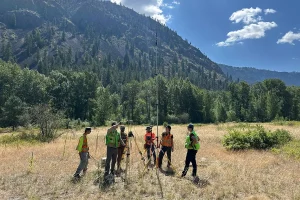
Spend time with any surveying firm and you’ll hear the same frustration:

“We can teach them the tech. It’s everything else that’s the challenge.”

Employers aren’t struggling to teach someone how to use equipment, process data or pick up new software. Those things, while technical, are structured, trainable and repeatable.

What’s harder, and far less predictable, is everything that sits around it. 

–              How someone communicates

–              How they ask questions

–              How they handle pressure or uncertainty

–              How they interact with clients, colleagues and people on site

These are the skills that shape day-to-day performance and increasingly, they’re the ones employers feel are missing. 

Surveys back this up. Communication, teamwork and problem solving are now ranked above technical ability as the most important skills for early-career workers. These ‘soft skills’ aren’t soft at all, they’re foundational and that’s becoming harder to ignore. 

Yet they’re also the hardest to teach once someone is already in the job.

By the time someone walks through the door as a new hire, a lot of this is already set. How they communicate, how they handle pressure, how they read a situation, these patterns have been developing for years and are often deeply ingrained. They’re not impossible to change, but they’re not quick fixes either. 


A New Kind of Communication Gap

This isn’t about people lacking ability. It’s about how skills such as communication, confidence and empathy are developing differently. In many ways this feels like a translation gap between two worlds. 

Young people often communicate comfortably and authentically online, but those habits don’t always translate smoothly into workplaces that still rely heavily on phone calls, meetings, hierarchy and face-to-face interaction. Messaging, voice notes and short-form interactions are second nature. But workplaces still depend on in-the moment conversations, explaining ideas in real time and responding to situations as they unfold.

That’s where the gap starts to show. 

Communication isn’t just about speaking. It’s about reading tone, recognising discomfort, understanding pressure and adapting how you respond depending on the person in front of you. This is where empathy is built. And that’s not something you learn from a screen.

It doesn’t come from perfectly edited messages or curated online interaction, but through real-world experiences, awkward conversations, mixed age environments and learning how to navigate people face-to-face.

Despite being constantly connected, only a minority of young workers say they feel confident building professional relationships. Honestly, that’s pretty wild! Communication isn’t missing, it’s just developing differently.

And to be clear, this isn’t true for every young person. Research suggests the issue is more nuanced than “screens = no social skills”. But what does seem clear is that heavy digital communication and reduced face-to-face interaction can crowd out some of the experiences where empathy and confidence are normally built.


Why Surveying Feels It First

Despite all the technology, surveying is still a people business. Surveyors spend their days with clients, contractors, landowners and colleagues, often explaining complex issues and navigating conversations where people may be under pressure, frustrated or uncertain.

The technical side can usually be taught relatively quickly. Software can be learned. Processes can be followed. But the human side takes longer.

It requires something deeper than technical competence – the ability to read a situation, understand concerns and communicate in a way that reassures people, not just informs them.

And in surveying, that skill becomes visible very quickly.

When confidence isn’t there, projects can slow down, misunderstandings increase and trust becomes harder to build. Not because the technical work is wrong, but because the communication around it is missing.

And this is where the industry may be overlooking something important.

Empathy isn’t a soft skill. It’s a professional skill. A commercial skill. A trust-building skill.

It’s what allows someone to read the room, understand concerns, adjust their communication and keep situations moving forward productively. It helps people feel heard, reassured and confident in the person standing in front of them.

Because in reality, clients rarely judge surveyors on technical accuracy alone. They also judge them on clarity, confidence, professionalism and how they make people feel during the process.

When that human element is missing, even technically correct work can create friction, confusion and mistrust. But when it’s present, it strengthens relationships, improves collaboration and builds confidence in both the individual and the profession itself.

That’s why the industry notices the gap early. 

Surveying depends on technical accuracy.

 But it also depends on people feeling confident in the person delivering it.


Where These Skills Really Begin

This is where the conversation becomes bigger than the industry. 

Because these skills don’t start at work, they begin much earlier. Long before someone walks onto a site for the first time. 

In classrooms. Around dinner tables. In part-time jobs. In team sports. In awkward social situations. In moments where young people learn how to speak up, handle disagreement, build confidence and understand other people.

For teachers and parents, this will feel familiar. These are the same skills being developed through group work, presentations and real-world learning. And the more opportunities young people have to practise them early, the more confident they become later. 

Then add in the pandemic into the middle of key developmental years and it starts to make a lot more sense why employers are noticing a difference. Many young people didn’t just miss lessons during COVID.

They missed years of rehearsal. 
Rehearsal for communication, teamwork, confidence, conflict, presentation, collaboration and even face-to-face interaction. Real life became something many young people simply had less opportunity to practise.

Jonathan Haidt, author of The Anxious Generation, argues that these social experiences are far more important than we often realise:

“Attunement (deeply present) forms the foundations for later emotional self-regulation. Children who are deprived of this joyful, mutually trusting social experience often face emotional difficulties and exhibit erratic behaviour in their later years.”

While Haidt is discussing child development more broadly, the point is relevant. The ability to navigate relationships, communicate effectively and handle challenging situations doesn’t suddenly appear in adulthood. It is built gradually through repeated social experiences over many years. 


So What Can We Do?
The good news is, this isn’t a fixed problem. 

Confidence, communication and workplace skills can all be developed. But they need opportunities to be practised. 

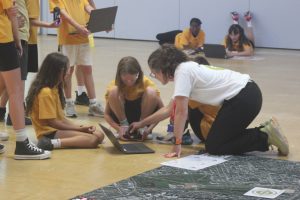
That can happen through programmes such as Design Engineer Construct (DEC) from Class of Your Own, geospatial outreach initiatives like Geoconnected, school projects, sports teams, part-time jobs, work experience placements and mentoring opportunities. 

We’re already starting to see education evolve in this direction. At Geo Business 2026, one example discussed on the Main Stage was the Bloxham Sustainability Challenge, which encourages sixth form students to tackle real-world sustainability problems through teamwork, research and problem solving. Unlike many traditional qualifications that focus primarily on subject knowledge and exam performance, the challenge places equal value on the broader skills that employers consistently say they need.

The programme has recently been awarded UCAS points, worth up to half an A-Level recognising that communication, collaboration and critical thinking are just as important as academic achievement.

As one student, Matilda Bonnington explained:

“There’s a push for getting the best grades but not for being personable or confident. This experience has helped to give me the skills needed to aid me with those real-life experiences that I’ll have to encounter.”

In many ways that is what employers are asking for more of: Rehearsal for real life. 

It’s a powerful reminder that preparing young people for the future isn’t just about knowledge. It’s about giving them opportunities to apply that knowledge, work with others and engage with real-world challenges.

It also requires industry to play its part. More companies opening their doors for work experience, shadowing opportunities and careers events would give young people valuable exposure to professional environments long before they apply for their first role. 

Initiatives such as Get Kids into Survey, Geoconnected and many others are helping raise awareness of geospatial careers, but awareness alone isn’t enough. Young people need opportunities to build confidence, communication skills and real-world experience alongside technical knowledge.

The earlier those opportunities begin, the stronger those foundations become.


Looking Ahead

This isn’t just about one generation. In many ways we’re only at the beginning of this shift.

The next generation growing up now, often referred to as Gen Alpha – is being raised in an even more digital first world. They’ll arrive with incredible strengths, especially around technology and adaptability, but likely even less exposure to the kind of face-to-face, mixed age interaction that builds confidence, empathy and real-world communication.

Which means this isn’t a short-term challenge. It’s the direction things are heading. And if Gen Z is the first generation exposing this shift in the workplace, Gen Alpha may be the generation that forces us to finally address it.


Final Thought

The conversation around surveying has long focused on attracting more young people into the profession. 

That’s still important.

But perhaps the bigger opportunity is helping young people develop the confidence, communication skills and real-world experience they’ll need when they arrive. 

Awareness opens the door.

Readiness helps them walk through it.

And building both starts much earlier than we think.


Sources and Further Reading:

Deloitte Global Gen Z and Millennial Survey 2025
https://www.deloitte.com/ce/en/issues/work/genz-millennial-survey.html

Haidt, J (2024). The Anxious Generation: How the Great Rewiring of Childhood is Causing an Epidemic of Mental Illness. Penguin Press. 

https://www.anxiousgeneration.com/book

National Association of Colleges and Employers (NACE) – Career Readiness Competencies
https://www.naceweb.org/career-readiness/competencies/

World Economic Forum – Future of Jobs Report
https://www.weforum.org/reports/the-future-of-jobs-report-2025/

McKinsey & Company – Defining the Skills Citizens Will Need in the Future of Work
https://www.mckinsey.com/featured-insights/future-of-work/defining-the-skills-citizens-will-need-in-the-future-world-of-work

OECD – Education and Skills Outlook
https://www.oecd.org/education/education-and-skills-outlook/

Uhls, Y. T. et al. (2014) – Five days at outdoor education camp without screens improves preteen skills with nonverbal emotion cues
https://www.sciencedirect.com/science/article/pii/S0747563214003227

Children & Nature Network – Research on screen time and emotional cue recognition
https://research.childrenandnature.org/research/screen-time-significantly-impacts-adolescents-ability-to-assess-face-to-face-nonverbal-social-and-emotional-cues-2/

UNICEF – Adolescent Mental Health and Wellbeing
https://www.unicef.org/mental-health

World Health Organization (WHO) – Adolescent Mental Health
https://www.who.int/news-room/fact-sheets/detail/adolescent-mental-health

Bloxham Sustainability Challenge https://www.bloxhamschool.com/bloxham-sustainability-challenge/

Photo Credits –
Image 2: NSPS Young Surveyors Network & WA Young Surveyors Network
Image 4: Kate Bartels, Geoconnected


Ambassador Spotlight ‘Monica Gilmore’

Welcoming Monica Gilmore from Mississippi, USA! Let’s learn some more about her:

How did you get into surveying? Executive Director for the Mississippi Board of Licensure for Professional Engineers & Surveyors

What are your plans as a Brand Ambassador? To share information about the career opportunities that exist in the surveying field, especially as it relates to the K-12 subgroup. To speak about and promote #Surveying and professional licensure whenever and wherever, possible.

Tell us a bit about what you do: Our agency is responsible for the review and approval for applications from individuals and firms to practice engineering and / or surveying in the State of Mississippi. In addition, we are also responsible for investigating complaints against licensees. Increasingly, we are also being responsive to K-12 outreach requests to introduce youth to career opportunities in engineering and surveying.

Anything else you’d like to add? As a state Agency we are responsible for $600,000 in grants fund on a biannual basis for ABET accredited engineering and surveying programs in the State of Mississippi.