Surveying Everest to the practical applications of GIS involving Covid19.
As a Geospatial community we are very lucky in the way that Covid-19 hasn’t had a drastic impact on our workload, compared to other industries (such as hospitality and tourism). We have been checking out some recent blog posts and compiled a few of our favourites. A mixture of topics for you to dive into…
Mapping tools for COVID-19 response
Responding to the covid-19 pandemic by observing the data and understanding the trends. This is how ArcGIS plays its part in the response, firstly it can monitor the current inventory of personal protective equipment (PPE) and the capacity and status of facilities. With other uses including monitoring the surge in graphs, managing testing sites by looking at demographics, and using StoryMaps to quickly communicate the changing situation to others. Read the full article here:
Linking to the previous article this demonstrates how the vaccination programme can be coordinated. It is getting launched in the UK very quickly, so ensuring the vulnerable people have access to the vaccine is vital, which requires a lot of planning. This article explains the possible uses of GIS with the tools within it, and their practical applications to the programme. Worth a read if you are interested, click here.
Combining light and sound to see underwater!
With the ocean covering about 70% of the earth’s surface, it’s shocking to know that only a small proportion of that has been subject to high resolution mapping. Mapping underwater however, is not easy. “The main barrier has to do with physics: Sound waves, for example, cannot pass from air into water or vice versa without losing most—more than 99.9 percent—of their energy through reflection against the other medium. A system that tries to see underwater using soundwaves traveling from air into water and back into air is subjected to this energy loss twice—resulting in a 99.9999 percent energy reduction”. Read more to discover how the Photoacoustic Airborne Sonar System works on this blog.
Which school subjects are involved in mining?
This is a must see video especially if you have kids in school and want to know how different subjects link to different careers. Might spark some new interests… Watch now
Mount Everest’s Changing Height
Now, you may have already seen this on the news as this story has been very popular with the press! Measuring Mount Everest! It’s grown?? By nearly a meter, the new official elevation announced on December 8 by Nepal and China. The two teams coordinated the results of their 2019 and 2020 surveys of the famous mountain to agree on the new elevation— 8,848.86 meters or 29,031.69 feet (height above sea level). Read it in full here.
Ambassador Spotlight ‘Trent Keenan’
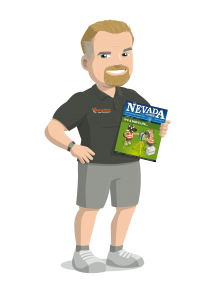
Meet our Brand Ambassador Trent Keenan from Nevada, USA.
Where did you study? I studied AutoCAD in Phoenix, AZ before becoming a land surveyor.
What are the requirements to be a surveyor in your area?For the State of Nevada, we require a bachelor’s degree in Geomatics
How did you get into surveying?My story is a little different than everyone else, I was in High School driving down the road and saw a couple of surveyors walk out to the intersection and thought, that is cool… A few days later and I am researching what it will take to become a land surveyor. And I am glad I did. 😊
How long have you been in the industry?This is my 25th year in the land surveying profession!
Are you part of any associations or organizations you would like us to mention? I have been involved in our local and state chapters of the Nevada Association of Land Surveyors since 2007. I am the past president of the local chapter 2011, and past president of the state association 2015, I am the current Nevada director on the Western Federation of Professional Surveyors (WestFed) and lastly, I am the current editor for our State Association quarterly publication called The Nevada Traverse.
Why do you want to be a GKiS Brand Ambassador?I am heavily involved in outreach for our local and state association as well as the chairman for outreach on the WestFed board, so its only fitting to use the GKiS brand to help promote the profession and attract the under generation!
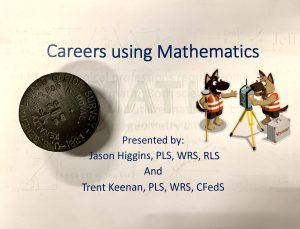
Why is it important for kids to know about surveying and the wider geospatial industry?There is a few reasons, but the main one would be to help kids understand that there is a career that will allow them to work in a lot of different fields all at the same time, using history, law, math and working indoors or outdoors all in the same day. The profession requires a lot of working knowledge in a lot of different subjects.
What are you going to do as an ambassador for GKiS? Help promote the GKiS brand, educate and mentor as many kids as possible through school career fairs, class presentations. And most of all bring awareness to the profession!
What are your hobbies? Photography, Running ½ Marathons, Biking, Hiking & Golf 😊
If you/your company had a GKiS character, what would it be? Already have one. Its myself and my two dogs!
What poster or resource would you like to see next from GKiS? Well Las Vegas of course!
Surveying through history
Surveying is one of the oldest professions in the world. It has occurred since humans built the first large structures.
Below are some examples, in history, of surveying:
The almost perfect square shape of the Great Pyramid of Giza, built c. 2700 BC, is evidence of the Egyptians’ use of surveying.
Stonehenge (c.2500 BC), in the South of England, was set out by prehistoric surveyors using “geometry” – from the Ancient Greek meaning “earth” “measurement”
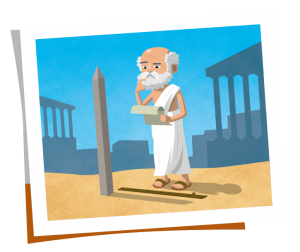
Eratosthenes was – amongst other things – one of the most important land surveyors of all time!Even though he lived over 2000 years ago – way before the time of scanners, satellites and sonar – he managed to work out the circumference of the Earth, the tilt of the Earth’s axis, and the distance from the Earth to the Sun!
He even made a map of the world with parallels and meridians, showing that he understood that the Earth was a sphere! And he worked all this out through measuring and comparing distances and angles on land. We think that makes Eratosthenes a Geo Survey Legend!
The Romans recognised land surveying as a profession. They established the basic measurements under which the Roman Empire was divided.
In the medieval period, groups of residents walked around their village to remind themselves of the boundaries. The group included people of all ages, the younger ones were there to make sure the ‘communal memory’ lasted as long as possible.
In 1086, in England, William the Conqueror commissioned the Domesday Book. It recorded the names of all the land owners, the area and quality of land they owned and specific information of the area’s content and inhabitants.
Mount Rushmore 1927: These giant sculptures were carved into the granite face of Mount Rushmore by Gutzon Borglum to commemorate four great American presidents. Three of them were also surveyors!
George Washington was made a county surveyor at the age of only 17 – just one year after going on his first survey expedition! He completed around 200 surveys and mapped about 60,000 acres of land.
Thomas Jefferson came from a surveying family. He used his knowledge to help him make deals to buy land that quadrupled the size of the growing United States in the 18th Century.
Abraham Lincoln managed to become a surveyor after only six weeks of study. He would later use this knowledge to help him buy and sell land and invest in local areas.
Although the fourth president on Mount Rushmore, Teddy Roosevelt, wasn’t a surveyor, he did do some mapping in the Amazon!
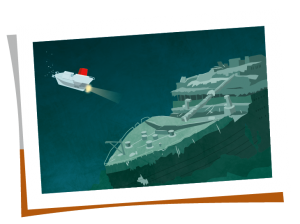
North Atlantic Ocean 1985: An underwater archaeologist named Robert Ballard in his submarine (‘Alvin’), exploring the North Atlantic Ocean floor at a depth of over 12,000 feet… in which he discovered something incredible: the wreck of the Titanic! Ballard had previous experience mapping underwater regions using sonar technology, but this find would put him on the map as an intrepid underwater explorer! However, the really cool part of Ballard’s story was that his mission to locate the Titanic was actually a cover-up for a secret military operation to find and explore the USS Thresher and the USS Scorpion, two American nuclear subs that sank in the 1960s! This sneaky spy stuff makes Robert Ballard a super cool surveyor!
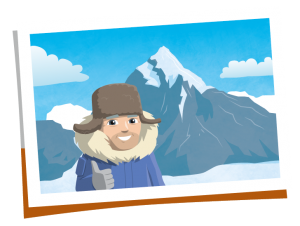
Mount Everest 1999: Bradford Washburn was an expert cartographer, or map-maker, and the images he captured of remote and dangerous places are still used by climbers today. He used to hang out the side of a plane while his wife piloted; she would make daring fly-overs of treacherous areas while he snapped pictures from angles that no-one else dared to try and reach. In 1999, Washburn updated the official height of the world’s tallest peak – Mount Everest – to 8850m. He used special survey equipment to help make sure this reading was as accurate as possible… and he was 70 years old at the time! That makes Bradford Washburn a certified survey legend.
Ambassador Spotlight ‘Dave Dagostino’
Introducing Dave Dagostino a fabulous Brand Ambassador who does a lot of work for us!
What do you do and what company do you work for? CEO and owner of Dagostino Geospatial, Inc.
Are you part of any associations or organisations you would like us to mention?
Member: American Society of Civil Engineers (ASCE)
Member: American Society for Photogrammetry and Remote Sensing (ASPRS)
Member: Collier Building Industry Association (CBIA)
Member: Bonita Springs Area Chamber of Commerce
Member and company is a “sustaining firm”: Florida Surveying and Mapping Society (FSMS)
Why do you want to be a GKiS Brand Ambassador and why is it important for kids to know about surveying and the wider geospatial industry?
The need for getting more people into surveying is becoming a critical issue right now. As we all know the demographic for surveyors is aging quickly and we are not replacing surveyors fast enough to keep up with demand. Getting kids exposed to surveying is so important as none of them even know who we are or what we do. Most adults know that either. I can hopefully be a small part of the solution of exposing kids to our profession and getting them interested in what we do.
What are you going to be doing as an ambassador for GKiS?
I would like to be able to set up presentations at all levels of schools to promote our profession. Also attend job fairs and career day events for kids to do the same. I am open to promoting GKIS in any way that you feel would be helpful to the organization as well as the profession.
How did you get into surveying?
I actually just stumbled into to it by luck. I was working at a grocery store right out of high school and ran into a surveyor. He explained what he did and it sounded interesting to me. He gave me a contact and I wandered into a survey office 34 years ago and never left – ended up with a B.S. in Surveying & Mapping from The University of Florida in 1995 and have had my own company since 1998
What are your hobbies?
In my spare time I enjoy family time with my wife and kids, all Gator athletics, being a student of business and entrepreneurship.
If you/your company had a GKiS character, what would it be?
A Survey Gator of course 😊
What poster or resource would you like to see next from GKiS?
I really enjoy the coloring pages for the younger kids. Maybe something geared more towards middle school age kids – a little more technical and in depth.
Character Spotlight ‘Surveyors Supply Co Inc’
Introducing Kaha loa, our new fantastic sponsor Surveyors Supply Co Inc’s new character!
Company Name – Surveyors Supply Co. Inc.
Location – Waipahu, Hawaii, USA
Why did you get involved in Get Kids into Survey? A few years ago I saw the posters being handed out at our annual Hawaii Land Surveyors Conference and thought what a great idea. I was never taught anything in school about surveying and how important it is. The more we can do to promote the various areas of surveying the better. And the technology today is moving so fast making it more efficient and cooler! When my son came to work for us 5 years ago out of high school, he was unfamiliar with the work and never learned anything about it in school either. So he started learning the instruments and equipment and now trains companies how to use them. It has opened up a whole new world for him.
What do you do? We sell construction and surveying supplies and equipment around the Pacific islands.
How long have you been in the Survey Industry? Our company has been in business for 51 years.
How did you get into the Industry? My father-in-law started a business like ours in Alaska out of the need for wooden stakes to be used for building roads. No one was manufacturing them at the time so he stepped in and started to. He then started a retail business in Alaska. When this business opportunity became available in Hawaii he purchased it. That was 30+ years ago.
Funny Fact about the you – I will always eat hot french fries (chips) in the car while driving. A soggy cold fry is no good.
Favourite piece of kit and why? The brand new Leica GS18i, GNSS Receiver with Integrated Tilt Compensation & Imaging Sensor Allows you to Capture Data Quickly & Efficiently in Areas That Were Not Previously Possible with Conventional GNSS Equipment. Combines Point Cloud Data & GNSS Data Into 1 Georeferenced Image Group to Create a Detailed 3D Model of your Project Site Without the Need for a Laser Scanner or 3D mapping Device. It’s so efficient!
Favourite Survey technique and why? UAV LIDAR / Photogrammetric Mapping, Fastest & Most Efficient Data Collection Method for Large Scale Mapping Projects. Very Versatile & Allows for many Different Data Deliverables including georeferenced orthometric photographs & Digital Terrain Models. What a time saver!
Character details; name, what does the character represent/ meaning behind it/him/her? Our characters name is Kaha loa (2 words) which is the Hawaiian name for “turn and then go straight for a long distance” . That pretty much sums up any Surveyors job.
Getting into a Geospatial Career
If you imagine your younger self thinking of what you wanted to be when you were older, didn’t it seem like such a daunting task? What do I want to spend the rest of my life doing? Do I choose something that pays well or something that I enjoy? A safe 9-5 office job or take a risk and work for myself? Will it be too stressful? Will I be any good? What if I’m not successful. Can I change my decision later? These are all possible questions that you ask yourself.
No matter what we do, kids are always going to have these worries about career choices. That’s what we do, we worry about the unknown. However, if you were more exposed to different career options and pathways at a younger age, you might not be so worried about thinking you have 5 choices and must make yourself fit the mould; teacher, doctor, vet, fireman, lawyer, you know the drill. Instead we want to expose kids to a multitude of careers that not even their parents may know exist. That is the exciting thing. There is something for everyone and we just have to let kids know that they don’t ‘have’ to fit the mould. They can make their own path, we just have to give them the tools and the exposure to different industries not showcased in the public eye. As they say, ‘knowledge is power’.
Here at Get Kids into Survey, our mission is to bring young people into the exciting world of survey and geospatial through pioneering content and engaging experiences. To expose them to the diverse opportunities within our industry from a young age.
To become a surveyor you’ll usually need a professional qualification approved by the Royal Institution of Chartered Surveyors (RICS), CICES, ABET or equivalent. In the UK you do not have to be a member of either however, this may limit what you can do and who you can work for. Full members of RICS call themselves chartered surveyors and are generally more property based. In comparison to being a member of CICES which is more engineering surveying and commercial management. If this is the route you would like to go down, that can be followed by applying to be a chartered engineer through the Engineering Council.
To become a Chartered Surveyor whether you’ve just come out of university or you’ve been working with a company, are required to take an Assessment of Professional Competence. There is another assessment to take before this to become an Associate which is the entry-level RICS qualification and offers the chance to progress to full chartered status. More information on becoming chartered here. There are multiple levels to CICES membership, with the two main professional grades being Technical member (TCInstCES) and Member (MCInstCES). For a more detailed descriptions of all the options look here.
Lower School Options (pre 18): Usually to get into higher education you’ll need 2 to 3 A levels, or equivalent. Subject choice is important even at this early stage and can help with the understandings of the basics. Good choices include:
Maths- with a maths extension if you can.
Economics
Geography
Geology
Physics
Design Engineer Construct! is a secondary school aimed accredited learning programme by Class of your Own. The result is having young people with real-world practical experience and employability skills. So being involved in projects like this will definitely help build up your skills if this is something your school can get behind. If you are a teacher and interested in applying this to your school then check out this link.
University: “If the university lifestyle appeals to you and you want to study a subject leading to a fast-paced, high-tech career, then a surveying-related degree could be ideal for you.
There are more than 300 courses in the UK alone, so there’s a surveying course suited for you – no matter where you want to study or what your career ambitions are” (RICS).
They could include:
surveying
business studies
economics
estate management
land and property development
Taking an accredited degree can be the first step to becoming a surveyor. Whether that is undergraduate study or postgraduate. This is because the relevant organisations work in partnership with universities to ensure that the accredited degree courses are relevant to industry. So when studying, your qualification will be recognised by employers as the benchmark of quality. Find courses here: http://www.ricscourses.org/Course/# or https://www.cices.org/membership/about/courses/.
Apprenticeships (16 plus): You could do a chartered surveyor degree apprenticeship. Also the geospatial survey technician level 3. You will usually need 4 or 5 GCSEs at grades 9 to 4 (A* to C) and A levels, or equivalent, for a higher or degree apprenticeship. This will be partly studying in school and partly out getting hands on. Search opportunities on the Government website (UK).
There are two levels of apprenticeships. At age 16 you can study a level 3 course, and then at 18 can study for the level 5 or 6.
There is a level 6 option which is geospatial mapping and science specialist. This is equivalent to a Bachelors degree. Find out more here.
T-Levels (age 16)– Mike from RICS introduced the concept to us, where students can gain practical work experience whilst studying 14 key modules in college (20:80 split). Work placements are scattered between the college work, with three exams at the end of the second year. It has been developed in collaboration with industry employers and professional bodies, including RICS and CICES.
*Could your business help train the next generation of surveyors? To find out about the benefits of offering a T-Level work placement, visit the government’s website, or email Mike Cox at mcox@rics.org.
Work Progression: If you have a higher national diploma or foundation degree in surveying or construction, you may be able to work as a surveying technician, and take further training on the job to qualify as a professional surveyor, or to specialise into a specific field. This is similar to progressing and diversifying into your niche of preferred work.
Development scheme: You could get a postgraduate qualification through a graduate trainee scheme with a company to work for (through RICS or CICES which offer special schemes); The Survey School run by the TSA provides a great 2 year block release course as well as other short courses. Education is also available through distance learning with the University College of Estate Management.
Becoming a Surveyor in the USA
American Specific University Study– Taking a ABET (or similar) accredited course provides a great base. “We are a nonprofit, non-governmental agency that accredits programs in applied and natural science, computing, engineering and engineering technology.
ABET accreditation provides assurance that a college or university program meets the quality standards of the profession for which that program prepares graduates.
We accredit programs, not institutions. We provide specialized accreditation for post-secondary programs within degree-granting institutions already recognized by national or regional institutional accreditation agencies or national education authorities worldwide.
Our accreditation is voluntary, and to date, 4,307 programs at 846 colleges and universities in 41 countries have received ABET accreditation. Over 100,000 students graduate from ABET-accredited programs each year, and millions of graduates have received degrees from ABET-accredited programs since 1932”.
Unlike other countries, each state in the US has different requirements for becoming a surveyor. Each state has their own licensing board which is often referred to as the Board of Registration. Education requirements and experience requirements vary state to state as well.
In Indiana (where our Brand Ambassador Ryan is from) for example you must have an associates degree with 27 credit hours in specific land surveying courses. You must work under the direct supervision of a Professional Surveyor (PS) for 2 years and then you can take the Surveyor Intern exam. Once that exam is passed there’s an additional 4 years working under a PS before you can sit for the PS exam. Once all of that has been completed you are able to practice on your own.
All states have some sort of combination of education and experience. Some require a Bachelor’s degree and 2 years of experience. A few states have a path to licensure where no education is required but you have to work under a PS for 10 years. For more information about the qualifications required by the respective states for designation as a Professional Surveyor, visit this site.
Becoming a Surveyor in Australia
Australian TAFE Qualification: “Work with civil engineers, builders, project managers and architects in the design and construction of major projects such as commercial buildings, bridges, roads, dams, tunnels and railways. Civil Construction and Surveying courses offer students a chance to gain hands-on experience and apply their expertise in the construction industry.
TAFE NSW qualifications can lead to careers in a range of different industries and sectors from roads to mining to residential to defence”. Find out more here.
Australia Specific University Study: Attending University to obtain a degree (Associate, Bachelors or Bachelors with Honours) – the entry requirements and prerequisites differ in each state. Find more detail about each state and the courses available from this link.
Becoming a Surveyor Worldwide
Extra Curricular: Gaining work experience is one of the most important things you can do. Not only does this show how keen you are to learn the skills needed for the job, it also tells you if the career is what you expected, which at this point you could alter your career path to suit something that is more suited to you.
If work experience isn’t an option for you, volunteering certainly is. Volunteering not only looks good on your CV, but it helps you get a grounding and gaining life skills. It does not have to be within the industry, any volunteering is valuable.
There are a wide variety of sectors and routes to go down in this industry. Nicely demonstrated in this image:
A great representation by Geospatial Jobs showing which sectors the Geospatial Graduates of today want to go into. There are so many options within each of these sectors too. Lots to explore and grow with as you gain more experience and opportunities. Further specialisation can be made with further qualifications for career progression.
Challenges in recruitment in the sector: It is clear from the ongoing needs of the construction industry that there will be a significant shortfall in the number of suitably qualified individuals to take up post in organisations working on the huge infrastructure projects that the UK will be embarking on over the next 10 to 20 years The shortfall in construction skills is mirrored in the supporting geospatial profession which provide the foundations to most of these projects so play a critical role.
“Both the University of East London and Newcastle University have seen a long-term trend of falling numbers of students applying to study specialist geospatial degree courses. The Design Engineer Construct! curriculum, which features geospatial engineering, has had its parity with GCSEs and A levels removed by the Department for Education, making it less viable for schools to offer”.
Solutions to the Challenges: The Industrial Strategy: Construction Sector Deal published in July 2018 refers to the investment of an additional £406m in maths, digital and technical education, helping to address the shortage of science, technology, engineering and maths (STEM) skills. Which will be a big boost to the geospatial industry as we are very much included in this and the digital aspect.
Kids often do not have the understanding of what the geospatial industry is. With a lack of applied activities in school even though they are learning the content. The major problem is that teachers, parents and the children do not know the career options available or the possible high earnings for those professionals that come with it. As mentioned previously the Design Engineer Construct is here to try and teach more about the opportunities within the industry to secondary school ages. In lower years Get Kids into Survey is trying to expose the industry in a fun way, including it in posters which are branching out into Q&A’s and lesson plans too. Schools are encouraged to have geospatial engineers and survey firms to come in to deliver assemblies and regularly engage with the kids. Lastly, the Adopt a School programme from Class of Your Own partners construction firms (including geospatial engineering businesses) with schools and offers site visit opportunities and hands-on demonstrations of geospatial equipment and software.
In the Geospatial Engineering Education report the Geospatial Commission are provided with a list of proposed changes and targets in order to help the industry progress. Some of these suggestions include: ensuring long term funding is available for more apprenticeship based learning, : Geospatial academia and research bodies are asked to work with industry and professional bodies to ensure opportunities are present to everyone, Geospatial academia and industry and professional bodies are asked to improve liaison with STEAM and geography teachers, and that careers information is available from a young age.
Advice for current students:
How do you ensure a job is right for you? “Knowing if a job is right for you is such a circumstantial question, I think. In my opinion, the most important thing is that you be interested in the core of the role. For me, it’s chatting with people/socialising, for surveyors, it may be geography, or math, or being outdoors. Surveying can see you in the middle of the bush, or on top of a 28-story high rise in the city, or hundreds of metres underground; this is great, because there’s a branch for almost everyone. But you have to be excited, and love what you do” -Sarah Clark
Katie Holt explains “There are lots of exciting career choices in surveying – you could be involved in construction and helping to make sure projects are built correctly, in the right place or you could be using drones, laser scanners and other instruments to produce plans and maps of areas. There are plenty of opportunities for varied work and travel within your country and overseas.”
Linking back to another blog by James Gibbs, he asked the question ‘What advice would you give to someone starting a geospatial career?’ in which five geospatial experts gave their advice. Some key messages that I took away from this were:
-Curiosity is key… ask those questions, dig deeper and make connections. The more you show genuine interest and willingness to learn the further you will go.
-Technology is advancing at a rapid rate, which leads to never ending opportunities where the only limit is your imagination! Especially in recent years the development of tools used in space, collecting data through environmental observations, navigation and communications.
-Don’t be afraid to question how and why things are done in a certain way. New ideas come from new perspectives, that might just happen to be you!
-Your first job doesn’t need to be your final job. You are free to follow your interests when different and new opportunities present themselves.
‘State of Geospatial Engineering Education’ Submission to the Geospatial Commission September 2019.
What is Map Making?
Map making is also known as Cartography, they both mean the same thing, this is, using geographical information and transforming it into a map.
As you’ll maybe know from seeing maps in school and at home, a map is a graphic which shows a simplified picture (or visualisation) of some of the features of a location/area (also known as, spatial data) it is representing.
Over the years, map making has been developed by various occupations joining forces to produce maps using COOL technology, e.g., land surveying, satellite remote sensing, aerial photography, geographical information systems, photogrammetry, & hydrography.
Map making uses skills from subjects like art, geography, science, and technology. It’s a FUN and CREATIVE profession, and there is a high demand for skilled map makers as an occupation. Map making can lead you down an avenue of lots of opportunities, including the use of GIS (Geographical Information Systems) which is a career in itself.
How to spark interest with your kids:
Start off by going out for an exploration of your local area. Pick an area with a few key objects eg a bridge, path and pond. Using objects around you, map this out using stones, sticks and grass (or whatever you can find) to create your own little nature map! Once you’ve finished remember to put back or clear out of the way the items you used.
National Geographic have created a really simple map making web page. Here you can create all sorts of different maps. Some examples of the layers you can add are the ranges of where the Big Cats are currently occupying, natural disaster hotspots, and political factors like boundaries. These can be layered as you wish, with a base map of your choice. Worth checking out with your kids if you have some spare time! Find it here.
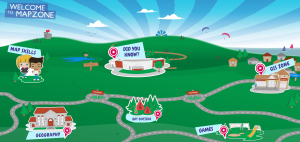
Map making comes with a whole host of topics that need to be understood… contour lines, scale, measuring distance, grid references, compasses and directions, and learning all the map symbols! Mapzone has been created by Ordnance Survey to try to educate children (of whatever age) about all of the skills mentioned above… plus lots more in other aspects of geography if you are extra keen. Have a look here.
Character Spotlight ‘Seiler’
Company Name – Seiler Geospatial.
Location – Midwest United States (we have offices in MO, KS, NE, WI, MI, IN, IL).
Why did you get involved in Get Kids into Survey? We loved the idea of promoting and supporting continuing education. The Seiler family have supported continuing survey education with equipment donations and scholarships to many of the Midwest surveying colleges and universities across the Midwest.
What do you do? Our core strength is supporting the Geospatial Industry by continuously expanding and evolving to promote and educate our customers on new technologies and industry trends. Seiler Instrument is one of the largest Authorized Trimble Distributors in the Midwest and a premier distributor for several other high quality hardware and software products. We are dedicated to our clients’ success by providing the best hardware, support, and software tools that fit their specific workflows, which ensure efficiencies and profitability. Our products include Survey Optical, GNSS, Data Controllers, 3D Scanning, Drones, Mapping GIS, Utility Survey Systems, Field and Office Software and much more. Our family owned business has a complete satisfaction purchase policy and we are committed to our customers’ complete satisfaction.
How long have you been in the Survey Industry?75 years – this year is our 75th Anniversary!
Tom Seiler, Louise Schaper, Eric P Seiler, Elaine Seiler, Rick Seiler
How did you get into the Industry? Seiler Instrument was founded in 1945 by Eric H and Dora Seiler. Today the family business is headed up by Chairman Eric P. Seiler-2nd generation, President and CEO Rick Seiler, Louise Schaper and Tom Seiler all the third generation. Kurtis Schaper, Eric Seiler III, and Matt Seiler comprise the 4th generation also working at Seiler Instrument. Our founder Eric H. Seiler helped create a company and culture of hard work, excellence in quality, service, reliability and integrity in Optical Instruments.
Did you know that Seiler Instrument/Seiler Geospatial, played an important role in surveying history as one of the original makers of surveying instruments from the United States, St. Louis area? Seiler founded Seiler Instrument Company in a small facility at 922 Pine Street, St. Louis, Missouri 75 years ago. Its primary service was the repair and overhaul of surveying instruments and microscopes. The company continued to grow and was soon manufacturing instruments designed by Eric H. Seiler. Most were Dumpy levels for the construction industry, but also included transits and theodolites. In 1956, the company outgrew its facility and moved to 1629 Washington Avenue in St. Louis and expanded again in 1968 when they moved to accommodate a complete optical manufacturing environment expansion to Webster Groves, Missouri. Today the family owns a 150,000 square foot facility in Kirkwood Missouri along with six other offices across the Midwest United States. We no longer manufacture surveying instruments, but are one of the largest resellers for Trimble Navigation in the Midwest United States.
Favourite piece of kit and why? The Trimble SX10 and Trimble X7 are the latest survey scanning and 3D modeling products to help surveyors do their job. Scanning and 3D modeling are the future of surveying, More and more people want and need to see additional data, thus with more data you can make better decisions.
Favourite survey technique and why? Surveyors use instruments to lay our property lines, housing and subdivisions and for infrastructure maps, topographic and aerial maps and much more. Surveyors are the ones responsible for maintaining land boundaries and boundaries are the basis of real property and wealth – e.g. where are my property lines and how much property do I own? Just about everything built needs a survey and surveyors are the first ones to be involved in locating and laying out what will be built. They ensure what is built is in the “right place.”
This website uses cookies to improve your experience while you navigate through the website. Out of these, the cookies that are categorized as necessary are stored on your browser as they are essential for the working of basic functionalities of the website. We also use third-party cookies that help us analyze and understand how you use this website. These cookies will be stored in your browser only with your consent. You also have the option to opt-out of these cookies. But opting out of some of these cookies may affect your browsing experience.
Necessary cookies are absolutely essential for the website to function properly. This category only includes cookies that ensures basic functionalities and security features of the website. These cookies do not store any personal information.
Any cookies that may not be particularly necessary for the website to function and is used specifically to collect user personal data via analytics, ads, other embedded contents are termed as non-necessary cookies. It is mandatory to procure user consent prior to running these cookies on your website.
Translation Options Hotsheet Download
Please fill out the form below to access our Translation Options Hotsheet:
Monopoly Sponsor Info Sheet Download
Please fill out the form below to download our Monopoly Sponsor Info Sheet Download:
Autumn Poster Hotsheet Download
Please fill out the form below to access our Poster Hotsheet:
Summer Poster Hotsheet Download
Please fill out the form below to access our Poster Hotsheet:
Spring Poster Hotsheet Download
Please fill out the form below to access our Poster Hotsheet:
Poster Hotsheet Download
Please fill out the form below to access our Poster Hotsheet:
Re-Print Hotsheet Download
Please fill out the form below to access our Re-print Hotsheet:
Winter Poster Hotsheet Download
Please fill out the form below to access our Poster Hotsheet:
Homework Project Info Pack
Please fill out the form below to access our Homework Project Information Pack:


 Where did you study?
 Why do you want to be a GKiS Brand Ambassador?
  What are you going to do as an ambassador for GKiS? Help promote the GKiS brand, educate and mentor as many kids as possible through school career fairs, class presentations. And most of all bring awareness to the profession!
 Eratosthenes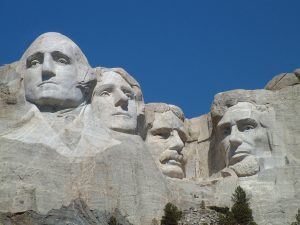
 North Atlantic Ocean 1985:
  Mount Everest 1999:
  What do you do and what company do you work for?
 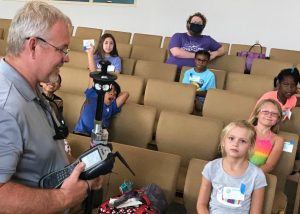 What are you going to be doing as an ambassador for GKiS?

 University: “If the university lifestyle appeals to you and you want to study a subject leading to a fast-paced, high-tech career, then a surveying-related degree could be ideal for you.
 Australian TAFE Qualification: “Work with civil engineers, builders, project managers and architects in the design and construction of major projects such as commercial buildings, bridges, roads, dams, tunnels and railways. Civil Construction and Surveying courses offer students a chance to gain hands-on experience and apply their expertise in the construction industry.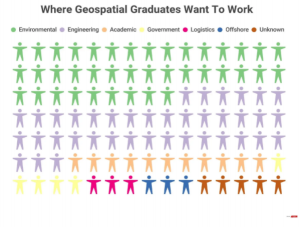
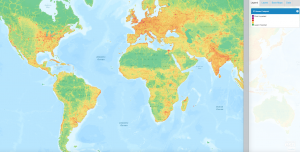
 National Geographic have created a really simple map making web page. Here you can create all sorts of different maps. Some examples of the layers you can add are the ranges of where the Big Cats are currently occupying, natural disaster hotspots, and political factors like boundaries. These can be layered as you wish, with a base map of your choice. Worth checking out with your kids if you have some spare time!
  Map making comes with a whole host of topics that need to be understood… contour lines, scale, measuring distance, grid references, compasses and directions, and learning all the map symbols! Mapzone has been created by Ordnance Survey to try to educate children (of whatever age) about all of the skills mentioned above… plus lots more in other aspects of geography if you are extra keen. Have a look
  Company Name
 Did you know that Seiler Instrument/Seiler Geospatial, played an important role in surveying history as one of the original makers of surveying instruments from the United States, St. Louis area? Seiler founded Seiler Instrument Company in a small facility at 922 Pine Street, St. Louis, Missouri 75 years ago. Its primary service was the repair and overhaul of surveying instruments and microscopes. The company continued to grow and was soon manufacturing instruments designed by Eric H. Seiler. Most were Dumpy levels for the construction industry, but also included transits and theodolites.
  In 1956, the company outgrew its facility and moved to 1629 Washington Avenue in St. Louis and expanded again in 1968 when they moved to accommodate a complete optical manufacturing environment expansion to Webster Groves, Missouri. Today the family owns a 150,000 square foot facility in Kirkwood Missouri along with six other offices across the Midwest United States. We no longer manufacture surveying instruments, but are one of the largest resellers for Trimble Navigation in the Midwest United States.
 Responding to the covid-19 pandemic by observing the data and understanding the trends. This is how ArcGIS plays its part in the response, firstly it can monitor the current inventory of personal protective equipment (PPE) and the capacity and status of facilities. With other uses including monitoring the surge in graphs, managing testing sites by looking at demographics, and using StoryMaps to quickly communicate the changing situation to others. Read the full article here:
  Linking to the previous article this demonstrates how the vaccination programme can be coordinated. It is getting launched in the UK very quickly, so ensuring the vulnerable people have access to the vaccine is vital, which requires a lot of planning. This article explains the possible uses of GIS with the tools within it, and their practical applications to the programme. Worth a read if you are interested, click here.