
Character Spotlight “Geoscience Australia”

In today’s Character Spotlight, we discover a little more about one of GKiS’s awesome sponsors “Geoscience Australia”.

Company Name Geoscience Australia is Australia’s public sector organisation responsible for geology and geography. Positioning Australia is one of GeoscienceAustralia priority programs.

Location While our office is located in Canberra we operate infrastructure across all areas of Australia, Antarctica and the Pacific.

Why did you get involved in GKiS? Everything happens somewhere. By promoting the use and understanding of spatial data through GKiS we are hoping that both big and little kids will be able to take advantage of the vast amounts of open access data and services available to develop innovative solutions to important real-world problems.

What do you do? The Positioning Australia program aims to provide an accurate and reliable positioning capability to all Australians. This capability is being delivered through two complementary projects; a national network of continuously operating reference stations that will deliver 3 – 5 cm accurate positioning in areas with access to mobile internet and a satellite based augmentation system that will deliver a 10 cm accurate positioning capability across Australia and New Zealand. Together these capabilities will enable innovation and efficiency across a range of different sectors, including the location and management of utility services (such as those shown in the poster).

How did you get into the Industry? Geoscience Australia has been providing advice on surveying and mapping to the Australian people since 1910, when our predecessor agency the Australia Survey Office was established.

Funny Fact about You? The Positioning Australia program uses a network of GNSS receivers to monitor the movement of the Australian continent. Australia is one of the fastest moving continents travelling between 5 and 7 cm a year to the north-east or as was reported by the BBC the height of a Kangaroo every 20 years.

Favourite piece of kit and why? Low-cost GNSS receivers as these have made it possible for everyone to obtain an accurate position anywhere on the Earth.

Favourite Survey Technique and Why? Precise point positioning. This technique combined with low-cost GNSS receivers will enable high-accuracy positioning for mass market users.

Your Website www.ga.gov.au

What is your character and why did you choose it? Our character is a Tasmanian Devil. This is a uniquely Australian animal found only on the Australian Island of Tasmania. The Devil is currently under threat due to a genetic disease. By providing access to an accurate and reliable positioning capability, researchers will be able to better track the movements of these amazing creatures to understand their behaviours and help keep the remaining populations safe for generations to come.

Character Spotlight “SheMaps”

In today’s Character Spotlight, we discover a little more about one of GKiS’s awesome sponsors “SheMaps”

Company Name: She Maps

Location: Australia

Why did you get involved in Get Kids into Survey? Dr Karen Joyce, one of our co-founders, is passionate about the spatial industry, and getting more kids to understand the potential of the industry and the technology involved, beyond what they think it is, is important. Get Kids into Survey is also just a really fun brand to be working with.

What do you do? You are all about increasing the diversity in the STEM workforce. We do this by working with schools to run drone programs. This is STEM by stealth, as we weave into our programs a whole lot of information about the spatial industry, as well as providing real world applications, but the students often think they are just having fun flying drones!

How long have you been in the Survey Industry? Karen has been in the spatial industry as a remote sensing scientist for over 20 years.

How did you get into the Industry? When Karen was at Uni she chose her subjects by what would get her into the outdoors the most, and onto the Great Barrier Reef. With a love for the sciences and environmental monitoring in there as well, she was drawn towards remote sensing!

Funny Fact about you – Karen and Paul (our other co-founder) met when they were both serving in the Army. After Karen moved to Wellington in New Zealand, and being too cold for 2 years, they moved to Darwin, Australia in the tropics – from the freezer to the frypan!

Favourite piece of kit and why? Definitely drones! They are just so versatile and have enabled Karen to get highly detailed spatial data of her research sites.

Favourite Survey technique and why? Karen loves being able to set up a drone mapping mission on Heron Island on the Great Barrier Reef, and having her drone fly an autonomous mission, collecting data. It is just so satisfying to be able to work with this technology, to do something I only dreamed of being able to do when I started at Uni.

Your website: www.shemaps.com

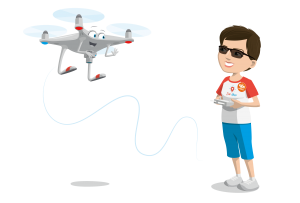
If you have a character; how did you choose and what does he/ she/ thing represent? Mean to you? We have Dronie – She is currently having a children’s book written about her adventures around Australia. Dronie represents all the women who have challenged themselves to overcome adversity and industry stereotypes and succeed in the STEM workforce. 

Character Spotlight “Position Partners”

In today’s Character Spotlight, we discover a little more about one of GKiS’s awesome sponsors “Position Partners”.

Company Name – Position Partners

Location – Australia, New Zealand, Asia

Why did you get involved in Get Kids into Survey? – We thought it was a great idea, well executed by Elaine and team! Kids don’t learn what surveyors do but they work with really cool technology so it was a great idea to promote the profession

What do you do? – Marketing Manager for Position Partners – we supply and support intelligent positioning solutions for the geospatial, construction and mining industries

How long have you been in the Survey Industry? – Our founding companies were brought to life more than 30 years ago. I’ve worked with geo technology suppliers for 13 years

How did you get into the Industry? Though the good fortune of meeting and working with Martin Nix

Funny Fact about you – I have a unique ability to memorise numbers but am hopeless at maths (I could never cut it as a surveyor!)

Favourite piece of kit and why? RPAS because who wouldn’t want to fly a remote control plane at work?

Favourite Survey technique and why? I don’t think I can comment on that, see fun fact above

Your website: positionpartners.com.au

If you have a character; how did you choose and what does he/ she/ thing represent?  Mean to you? Plumb Bob the Koala because they are unique and worth protecting, like the survey profession!

The Shared-Space Invader. Bringing Geography & Geo Survey to Life

Extra-terrestrial Investigations.

During lockdown, a group of key worker pupils from a Manchester primary school embarked on an out-of- this-world learning adventure! They were presented with an intriguing scene: a large crater in the middle of a street, caused by a strange object that had fallen from the sky, which lay buried at the end of a long, dark and foreboding tunnel. Since this was no place for human exploration, the group put their geo survey skills to the test to find a way to explore the tunnel safely, and discover the extra-terrestrial cause of the colossal crater…

Introducing the Project

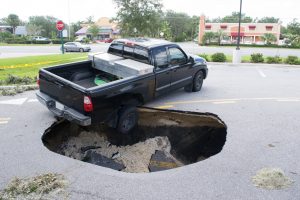
At the start of a series of lessons, the pupils were shown an above-ground image of a large hole in the middle of a street. They were challenged to adopt the persona of a member of the public, and describe what they came across as they approached the scene – paying particular attention to the most hazardous elements…

“…As I was walking down the pavement, I saw a group of people gathered together. They were being very noisy, shouting things like, “It fell from the sky!”, and, “What could be down that deep, mysterious hole!?” When I got closer, I realised what all the commotion was about. There was a huge crater right in the middle of the pavement! I could see broken utility lines spitting water and sparks of electricity. Even stranger, there was green smoke coming from the dark, gloomy hole. It smelled like rotten bananas! I wanted to get closer, but the police started pushing everyone back – I almost tripped over with the herd of people coming towards me. Suddenly, I saw these weird-looking scientists in strange suits going towards the scary crater, so that they could investigate this curious matter…”Year 4 Pupil

Diving Deeper

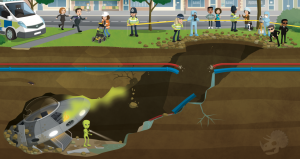
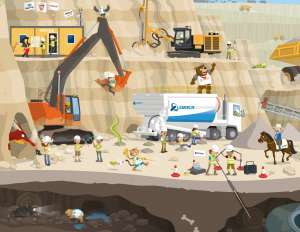
Having set the scene, pupils were given a sneak peek at what lay beyond the entrance to the crater, via the Get Kids into Survey Learning Sheet.
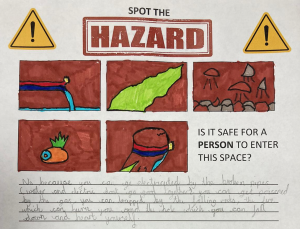
They explored the scene in detail, focusing on the various hazards – which were much more visible in the expanded image – in order to assess the viability of sending an investigation team into the tunnel.

The group managed to identify five separate hazards that might make the crash site a no-go area for the investigators. They noticed that the broken utility pipes posed a problem – especially with the potentially catastrophic combination of electricity and water. They noted that the strange green smoke floating up through the cavity might well be toxic, and that where there is smoke, there is likely fire – just like the one on the alien’s ship! The group also identified the crumbling rocks as a hazard; one that could crush an investigator or cause a cave-in that would trap them underground. Finally, they identified the crater itself as a fairly hefty fall risk! All in all, the group agreed that it would not be safe for a person to enter the space… So how would the investigators ever find out what was down there?
Geo-tech to the Rescue

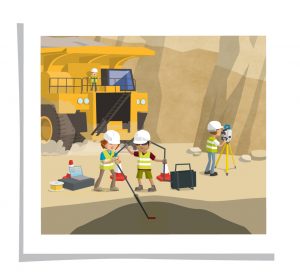
Using the Get Kids into Survey Mining Exploration Poster, pupils explored the technology that surveyors use to investigate and map cavities, caves, rocky areas and hard-to-reach places. They learned about LiDAR technology: devices that emit light rays and measure reflections to create a 3D image of a given space.

They also discovered that these scanning devices can be mounted to a variety of vehicles, turning them into mobile mapping systems.

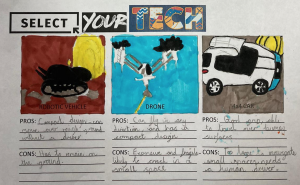
The pupils noticed that, in the poster, there were three mobile mapping systems: one where the LiDAR scanner was mounted to a robotic vehicle; one where a scanning device was fixed to a drone, and one where a LiDAR unit was mounted to a 4X4 vehicle. The pupils were asked to generate pros and cons for each of these systems in the context of exploring the underground tunnel from the street scene.
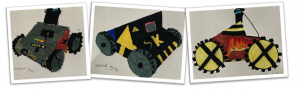
After weighing up their options, the group decided that a robotic vehicle-based mobile mapping system would be best suited to their exploration needs; it being small, able to traverse rough terrain, and operated safely via remote control. Now it was time to get to work on their very own prototype!

Lean, Mean, Mine-Exploring Machines

Having analysed the conditions under which their robotic vehicles would have to perform, pupils got to work on designing model prototypes for their own remote controlled, all-terrain modes of exploratory transport.

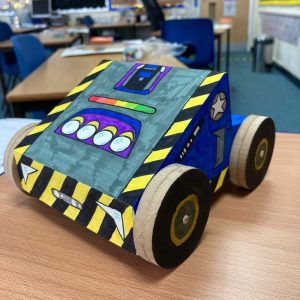
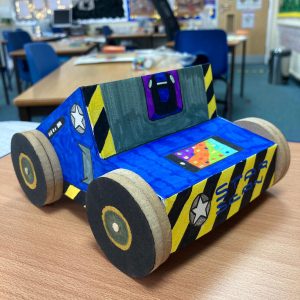
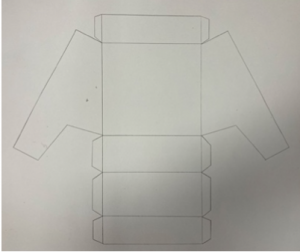
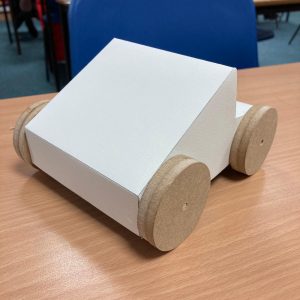
Pupils transferred these designs from 2D sketch work to a 3D net, creating a custom body to fit over a cardboard chassis. They added axels and large wheels for all-terrain performance.


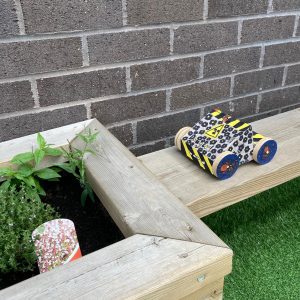
The result of the groups’ creative efforts was a set of prototype vehicles that looked like they could take on any survey situation, no matter how out-of-this-world it was! The children even took their models outdoors to put them through their real-world paces…
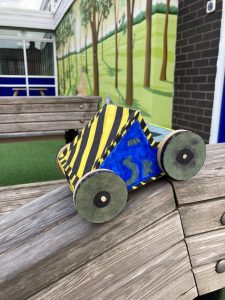
 

To round-off the project, the group used their drama skills to enact the discovery of the alien ship, and the reactions of the various people in the original scene. The pupils enjoyed the Shared-Space Invaders project immensely, and through the imaginative Get Kids into Survey stimuli, and a creative, cross-curricular teaching approach, they learned a great deal about cutting-edge professional technology, hazard safety, and the fascinating world of underground survey.
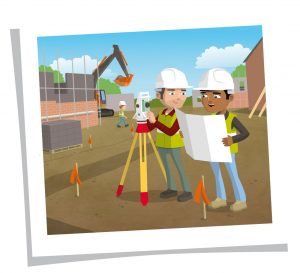
Report compiled by Mathew Sullivan, FRSA Teacher, Author and Educational Consultant

Find the Lesson Plan to this project on our Resource Page

Are there different types of surveys? 

Building Survey, a familiar type of survey is one done on your home. It is often completed to assess the condition of a house before it’s bought.  A building survey can look at any building’s construction and can work out if and how maintenance and repair needs to take place. 

Land Survey is where ‘land’, which can be defined as ‘solid surface of the earth’, is measured and it’s details are recorded. 

 Construction Surveys help figure out where man-made objects such as highways and bridges as well as buildings and pipes should be located.

Utilities/Infrastructure Surveys measure services above and below the ground. Infrastructure means the structures and facilities needed for an organisation such as water and power lines. 

Mining Surveys explore and estimate material below the surface of the ground. 

Hydrographic Surveys decide the geography of a body of water, including the depth, tide measurements, shoreline obstacles, and physical features of the body’s floor. 

Aerial Surveys gather information and images from airplanes, helicopters or other aerial methods.


(Please Note: this is an open blog which will be updated and edited on a regular basis)

Character Spotlight “UPG”

Get Kids into Survey presents “UPG”

In today’s Character Spotlight, we discover a little more about one of GKiS’s awesome sponsors “UPG”.

Company Name:  UPG

Location:  Australia

Why did you get involved in Get Kids into Survey?  Survey is a profession resulting in being educated in STEM subjects. It’s not well known and is a mix of those disciplines enacted in the real world.

What do you do?  Enable surveyors / geospatial professionals with the most practical and efficient technology solutions.

How long have you been in the Survey Industry?  UPG is part of The Herga Group and was founded in 1888 in Brisbane.  Between 1939 – 1945 Herga repaired instruments for the US forces at night.  In 1927 the group was appointed as the Australian Dealership for geodimeter.

How did you get into the Industry?  Surveying is one of the oldest professions and they need technology to perform their work

Funny Fact about the company? UPG the dynasty – Run now by a fourth generation Bright

Favourite piece of kit and why? Trimble TSC7. It’s the conductor of an orchestra of hardware solutions.

Favourite Survey technique and why? Integrated surveying. Ties in many hardware technologies with the TSC7.

Your website: www.upgsolutions.com

What is your character and why did you choose it? 

The Trimble SX10 & TSC7 aka ROBO & FLASH

The TSC7  solves the problems with its SX10 sidekick.

The TSC7 is the conductor of an orchestra or in this case – of the SX10.

The TSC7 is the newest play on a field controller taking it to next level of speed and capability.

The SX10 is next level productivity and combined with the TSC7 are an exciting duo of technology.

Cutting edge and best practice.

Character Spotlight “Geoscience Australia”

Get Kids into Survey presents “Geoscience Australia”


In today’s Character Spotlight, we discover a little more about one of GKiS’s awesome sponsors “Geoscience Australia”.


Company Name

Geoscience Australia is Australia’s public sector organisation responsible for geology and geography. Positioning Australia is one of Geoscience Australia’s priority programs.


Location

While our office is located in Canberra we operate infrastructure across all areas of Australia, Antarctica and the Pacific.


Why did you get involved in GKiS?

Everything happens somewhere. By promoting the use and understanding of spatial data through GKiS we are hoping that both big and little kids will be able to take advantage of the vast amounts of open access data and services available to develop innovative solutions to important real-world problems.


What do you do?

The Positioning Australia program aims to provide an accurate and reliable positioning capability to all Australians. This capability is being delivered through two complementary projects; a national network of continuously operating reference stations that will deliver 3 – 5 cm accurate positioning in areas with access to mobile internet and a satellite based augmentation system that will deliver a 10 cm accurate positioning capability across Australia and New Zealand. Together these capabilities will enable innovation and efficiency across a range of different sectors, including the location and management of utility services (such as those shown in the poster).


How did you get into the Industry?

Geoscience Australia has been providing advice on surveying and mapping to the Australian people since 1910, when our predecessor agency the Australia Survey Office was established.


Funny Fact about You?

The Positioning Australia program uses a network of GNSS receivers to monitor the movement of the Australian continent. Australia is one of the fastest moving continents travelling between 5 and 7 cm a year to the north-east or as was reported by the BBC the height of a Kangaroo every 20 years.


Favourite piece of kit and why?

Low-cost GNSS receivers as these have made it possible for everyone to obtain an accurate position anywhere on the Earth.


Favourite Survey Technique and Why?

Precise point positioning. This technique combined with low-cost GNSS receivers will enable high-accuracy positioning for mass market users.


Your Website

www.ga.gov.au


What is your ‘Get Kids into Survey’ character and why did you choose it?

Our character is a Tasmanian Devil. This is a uniquely Australian animal found only on the Australian Island of Tasmania. The Devil is currently under threat due to a genetic disease. By providing access to an accurate and reliable positioning capability, researchers will be able to better track the movements of these amazing creatures to understand their behaviours and help keep the remaining populations safe for generations to come.

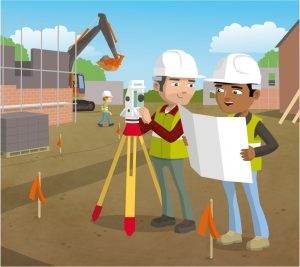
Why do we need Surveyors?

Surveyors transform the world around us. We need them to be involved in developing things like landscapes and cities, and for tackling global issues such as climate change and migration.

Surveyors do this by transforming and improving how people work and travel, where they live and by helping create safer, happier and healthier communities.

There are many different types of Surveyors, to tackle many different types of survey tasks.  A Surveyor can plot, measure and record the details and features of the land known as topography, utilising skills such as; maths and geography.  Surveyors use compasses and measuring devices such as 3D Laser Scanners and Theodolites – an instrument that measures angles.

By knowing where the features are located, and understanding how angles work, the surveyor can get a full 3D picture of the lay-of-the-land or sea.  By utilising special instruments, the surveyor can measure unsafe and hard to reach areas also known as remote sensing – collecting data without physically touching it.

All these things help us produce maps, understand where to build schools and even protect water ecosystems.

Surveyors can work alone, in teams, indoors and outdoors; on projects like the London Olympic Park, and greener transport systems.

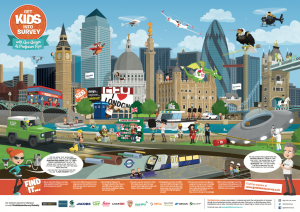
Click on the posters to investigate the different types of jobs surveyors can do and download the Q&A’s to see how savvy your survey power is!  Sign up to our monthly news to get resources, how you can help and competitions for the kids.