Surveying Monopoly has been created with one big vision: to bring the world of geospatial surveying into a household game that families around the world can play, enjoy and learn from together. Across the board, real surveying and geospatial organisations are represented by their own unique characters, places and technology, showcasing just how varied and exciting the profession can be.
But who are the characters taking their places on the board, and what do they tell us about the real world of surveying? It’s time to meet them! Through a quick-fire Q&A, we’ll discover the inspiration behind each character, their favourite surveying tools, what their organisation does, and even where in the world they’d most like to survey.
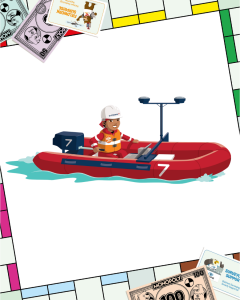
Let’s learn some more about Subsea7 and their character Sophia:
Company name and location? Subsea7, Worldwide
What is your name and what inspired your design? Beatriz Faria Melo. This design was inspired by the amazing crews who work on our vessels all around the world. They help make every survey adventure possible!
What tool would you never leave the office or field without? More than a tool, I would never leave without a checklist! We use lots of different sensors and equipment on hydrographic surveys, and they all have an important job to do. My checklist helps me make sure everything is ready before we head out and start surveying
Which square on the Surveying Monopoly board would your character most like to visit and why? My favourite place is the Survey Port. This is where I can check that all the equipment is working properly and that everything is ready to go. Once everything is up and running, the adventure can begin!
What is the coolest thing about surveying that kids might not know? The coolest thing about surveying is that we’re a bit like real-life treasure hunters! We use special equipment to explore the seabed, find interesting objects underwater, and create maps of places that many people have never seen.
How does your company help surveyors measure, map, or build the world around us? Subsea7 helps surveyors measure and map the seabed using special equipment on ships and underwater robots. The information we collect helps build things like offshore wind farms. We turn the underwater world into maps that engineers can use to build safely and accurately!
If you could travel anywhere in the world to survey, where would you go? If I could travel anywhere in the world to survey, I would choose the Mariana Trench in the Pacific Ocean. It’s the deepest part of the ocean and one of the least explored places on Earth. I would love to help map the seafloor there and learn more about what lives in the deep, dark ocean. It would be like going on a real-life underwater space adventure
+++
If you are ever looking for an inspirational person, who loves Survey and is an inspiration when speaking to kids Beatriz is on another level. She still brings a sense of wonder and excitement to her role, and is the personality behind our Sophia character.
Character Spotlight ‘QK4’
Surveying Monopoly has been created with one big vision: to bring the world of geospatial surveying into a household game that families around the world can play, enjoy and learn from together. Across the board, real surveying and geospatial organisations are represented by their own unique characters, places and technology, showcasing just how varied and exciting the profession can be.
But who are the characters taking their places on the board, and what do they tell us about the real world of surveying? It’s time to meet them! Through a quick-fire Q&A, we’ll discover the inspiration behind each character, their favourite surveying tools, what their organisation does, and even where in the world they’d most like to survey.
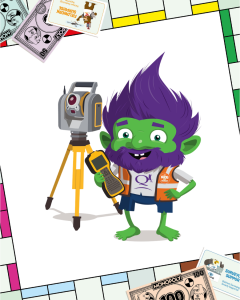
Let’s learn some more about QK4‘s character Benny the Bearded Troll!
Company name and location?Qk4, Inc. Kentucky USA
What is your name and what inspired your design?Benny the Bearded Bridge Troll is comfortable under bridges (he’s a troll after all). He works to keep everyone safe who needs to cross. At Qk4, we specialize in bridge surveys no matter what size and shape whether it is for transportation, railroads, or pedestrians.
What tool would you never leave the office or field without?For bridges, Benny loves to use a 3D scanner to capture all the unique bridge components in high res 3D.
Which square on the surveying Monopoly board would your character most like to visit and why?Benny always wins when he lands on the survey support squares form NSPS
What is the coolest thing about surveying that kids might not know?Land Surveying protects the value of your property by proving where the limits of your boundaries start and end. No one can argue if you have an accurate survey.
How does your company help surveyors measure, map, or build the world around us? Benny and Qk4 work to improve the lives of people in our community through accurate land surveys for homes, businesses, transportation, utilities and other projects.
If you could travel anywhere in the world to survey, where would you go?Benny loves bridges; so we would survey the world’s most special bridges like: The Golden Gate Bridge, The Tower Bridge, Ponte Vecchio, The Brooklyn Bridge, Akashi Kaikyo Bridge, or the Millau Viaduct.
Character Spotlight ‘Juliano Associates’
Surveying Monopoly has been created with one big vision: to bring the world of geospatial surveying into a household game that families around the world can play, enjoy and learn from together. Across the board, real surveying and geospatial organisations are represented by their own unique characters, places and technology, showcasing just how varied and exciting the profession can be.
But who are the characters taking their places on the board, and what do they tell us about the real world of surveying? It’s time to meet them! Through a quick-fire Q&A, we’ll discover the inspiration behind each character, their favourite surveying tools, what their organisation does, and even where in the world they’d most like to survey.
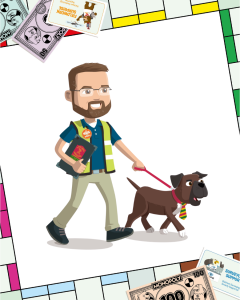
Christopher Juliano and Daryl. I wanted to memorialize Daryl since he is the rock of our office.
What tool would you never leave the office or field without?
Although not a tool, I cannot leave the office without taking Daryl for a ride. If it has to be a tool, then it would be my laptop.
Which square on the surveying Monopoly board would your character most like to visit and why?
Daryl will visit them all since he just loves meeting people.
What is the coolest thing about surveying that kids might not know?
It is the second oldest profession and combines map making, history, archeology, treasure hunting, and orienteering into one great profession!
How does your company help build the world around us?
We measure (survey) the land and design projects that provide people places to live, work, and play.
If you could travel anywhere in the world to survey, where would you go?
The UK. I am a huge fan of the old medieval towns and castles.
Character Spotlight ‘Trimble’
Surveying Monopoly has been created with one big vision: to bring the world of geospatial surveying into a household game that families around the world can play, enjoy and learn from together. Across the board, real surveying and geospatial organisations are represented by their own unique characters, places and technology, showcasing just how varied and exciting the profession can be.
But who are the characters taking their places on the board, and what do they tell us about the real world of surveying? It’s time to meet them! Through a quick-fire Q&A, we’ll discover the inspiration behind each character, their favourite surveying tools, what their organisation does, and even where in the world they’d most like to survey.
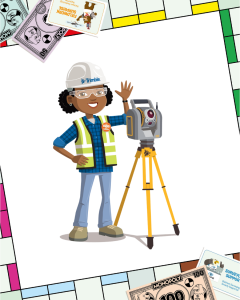
Let’s learn some more about Trimble:
Company name and location?
Trimble Inc. While our headquarters are in Westminster, Colorado, our coordinate system is truly global. We have team members and innovation centers in many corners of the world.
What is your name and what inspired your design?
Our token is a miniature version of the Trimble R980 GNSS receiver, one of our flagship products. It stands as a tiny testament to our long-standing legacy of pioneering satellite positioning technology.
What tool would you never leave the office or field without?
A solid pair of boots and a Trimble GNSS receiver. You can have the most advanced positioning technology in the universe, but it doesn’t mean much if your feet are soaked and blistered after a day out in the field.
What is the coolest thing about surveying that kids might not know?
Surveying is part time-travel, part sci-fi. One day you are looking for a wooden stake buried by someone in 1850 and the next day you’re using a 3D laser scanner to capture the as-built of a futuristic skyscraper.
How does your company help surveyors measure, map, or build the world around us?
Trimble bridges the gap between the physical and digital worlds. We provide the hardware, software and workflows that allow people to build roads that line up perfectly, bridges that withstand nature and buildings that shape the future
If you could travel anywhere in the world to survey, where would you go?
The Antarctic ice sheets. Testing our rugged gear in one of Earth’s most extreme environments to track glacial movement would be an unforgettable adventure.
Character Spotlight ‘Riegl’
Surveying Monopoly has been created with one big vision: to bring the world of geospatial surveying into a household game that families around the world can play, enjoy and learn from together. Across the board, real surveying and geospatial organisations are represented by their own unique characters, places and technology, showcasing just how varied and exciting the profession can be.
But who are the characters taking their places on the board, and what do they tell us about the real world of surveying? It’s time to meet them! Through a quick-fire Q&A, we’ll discover the inspiration behind each character, their favourite surveying tools, what their organisation does, and even where in the world they’d most like to survey.
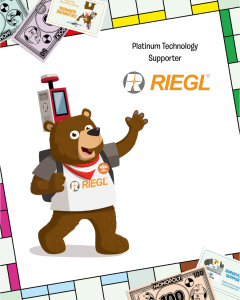
Let’s learn some more about Riegl’s Bernhard the Bear:
Company Name and Location
RIEGL‘s headquarters, or “main bear camp”, is located in Austria, and our North American headquarters is in the USA. With offices around the world, RIEGL supports customers wherever their adventures take them. Even more exciting, RIEGL scanners are helping customers tackle projects in amazing places near and far. Now we just need to put one on the moon!
What is your name and what inspired your design?
My name is Bernhard the Bear! One summer, while I was catching fish in a mountain stream by the Austrian Alps, I discovered a team of RIEGL engineers testing a LiDAR scanner on a drone. They showed me how LiDAR could create detailed 3D maps and digital twins, or virtual models of real-world places. Since I was such a curious bear, they decided to scan me, too! That scan became the inspiration for Bernhard the Bear, combining my love of adventure, the outdoors, and technology into one character.
What tool would you never leave the office or field without?
A RIEGL terrestrial laser scanner! I can pack it up, grab my backpack and a tripod, and head off to explore somewhere new. Whether I’m exploring a forest, a mountain, a bridge, or a city, I can help create detailed 3D digital twins, or virtual models of real-world places. And of course, I always bring a snack, because every bear knows adventures are better with food!
Which square on the Surveying Monopoly board would your character most like to visit and why?
The Fieldwork Surprise Square! It’s the perfect fit for an adventurous bear like me. One of the best things about being part of the RIEGL team is seeing the amazing projects our technology helps make possible. Every surveying project is different! You never know what exciting place you’ll explore, what challenge you’ll solve, or what new discovery might be waiting just around the corner.
What is the coolest thing about surveying that kids might not know?
Surveyors are like real-world explorers! They use advanced technology, like the innovative LiDAR systems developed by RIEGL, to capture incredibly detailed information about the world around us. This helps create maps and 3D views of places that can be studied, measured, and explored in new ways.
How does your company help surveyors measure, map, or build the world around us?
At RIEGL, we help surveyors become real-world explorers! Our LiDAR technology enables them to create detailed 3D views of forests, mountains, cities, bridges, and more. By capturing accurate information about the world around us, surveyors can help people build, protect, and better understand the places we live, work, and play.
If you could travel anywhere in the world to survey, where would you go?
I’d love to survey the moon someday! I know it’s not exactly in this world, but an explorer bear can dream. After learning about the incredible places that RIEGLtechnology helps document here on Earth, mapping the lunar surface would be the ultimate adventure. And who knows? Maybe I’d even leave the first bear footprint on the moon!
Character Spotlight ‘NSPS’
Surveying Monopoly has been created with one big vision: to bring the world of geospatial surveying into a household game that families around the world can play, enjoy and learn from together. Across the board, real surveying and geospatial organisations are represented by their own unique characters, places and technology, showcasing just how varied and exciting the profession can be.
But who are the characters taking their places on the board, and what do they tell us about the real world of surveying? It’s time to meet them! Through a quick-fire Q&A, we’ll discover the inspiration behind each character, their favourite surveying tools, what their organisation does, and even where in the world they’d most like to survey.
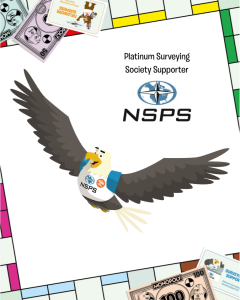
Let’s learn some more about NSPS’s Evan the Eagle:
🦅 Company name and location
“Evan the Eagle here! I represent NSPS (National Society of Professional Surveyors), and I soar out of Frederick, Maryland—right in the heart of some amazing American surveying history and landscapes!”
🦅 What is your name and what inspired your design?
“My name is Evan the Eagle! I was inspired by the idea of having a birds-eye view, because surveyors need to see the big picture. Eagles soar high, just like surveyors use drones, satellites, and mapping tools to understand the land from above!”
🦅 What tool would you never leave the office or field without?
“I never leave without my GNSS receiver (GPS gear)! It helps me pinpoint exact locations anywhere I fly, whether I’m mapping a park, a neighborhood, or a brand-new bridge.”
🦅 Which square on the surveying Monopoly board would your character most like to visit and why?
“I’d swoop straight to ‘Satellite Positioning Technology’! From up high in the sky, I love anything that connects satellites with what’s happening on the ground. It’s like having super-powered navigation wings!”
🦅 What is the coolest thing about surveying that kids might not know?
Surveyors make the invisible visible! Property lines, underground pipes, future roadsyou don’t always see them, but surveyors map it all. It’s like unlocking hidden levels in a game!”
🦅 How does your company help surveyors measure, map, or build the world around us?
“NSPS helps by supporting surveyors with advocacy, education, standards, and keeping up with the latest technology. That means better tools, more accurate maps, and safer, smarter ways to build everything from sidewalks to skyscrapers!”
🦅 If you could travel anywhere in the world to survey, where would you go?
I would head to Machu Picchu in Peru! Imagine mapping ancient ruins high in the mountains—talk about legendary property status! Plus, with my wings, I’ve already got the high-ground advantage!”
“And for a bonus stop closer to home, I’d glide over to Mount Rushmore! Surveying those giant carved faces would feel like landing on a Monument Level-Up square. Big rocks, big history, and BIG surveying bragging rights!”
School Outreach Made Simple
Inside the Get Kids into Survey Brand Ambassador Hub
Going into a school to talk about surveying sounds like a great idea.
But then come the questions…
What do I talk about? How do I explain surveying to a 10-year-old? Do I need to create a lesson? What activities could we do? And where do I even start?
The answer is: you don’t have to start from scratch.
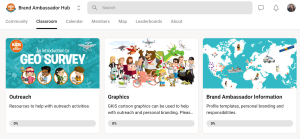
The Get Kids into Survey Brand Ambassador Hub, supported by Topcon, brings together resources, activities, presentations and advice designed to help geospatial professionals take surveying into classrooms.
Whether you have 20 minutes, an hour or a whole morning with a class, you can use the Hub to pick and choose what works for your visit.
What is the Brand Ambassador Hub?
The Hub is an online space on SKOOL for Get Kids into Survey Brand Ambassadors.
It’s where we bring together the resources that can help you plan and deliver outreach, from thinking about your first school visit to choosing a practical activity or downloading something for children to take home.
With the support of Topcon, we’ve been able to continue developing the Hub and give Brand Ambassadors more tools to take into their communities and classrooms.
The idea behind it is simple:
You already have surveying knowledge and real-world experience. We can help you turn it into something that works for children aged 8–12.
You don’t need to become a teacher. You don’t need to design an entire lesson plan. And you certainly don’t need to create everything yourself.
Start with a little preparation
If you’ve never delivered school outreach before, the Preparing for Outreach section is a good place to begin.
There’s a Preparing for Outreach Checklist, designed to help you think through what you might need before heading into a school.
We’ve also brought together Top Tips from Brand Ambassadors, using experiences from people who have already delivered outreach to share what worked, what engaged the children and what they would recommend to others.
It means your first school visit doesn’t have to feel like stepping completely into the unknown.
Need something to structure your session?
One of the easiest ways to start is with a presentation.
The Hub includes our Introduction to Survey presentation, an interactive introduction to what surveyors are, what they do and why their work matters, with questions and answers along the way to encourage children to get involved.
There’s also a Who are GKiS? presentation to introduce Get Kids into Survey and the wider mission behind what we do (more suitable for surveyors presenting in an adult conference setting).
But these don’t have to be the whole session.
Use them as a starting point and then add the thing children often find most interesting: your own experiences.
Show them a photograph from a recent project. Tell them about an unusual place you’ve worked. Bring along your PPE. Explain what the equipment in the back of your car actually does!
It doesn’t need to be complicated to be memorable.
Let them have a go
We know children learn differently, and sitting through an hour-long presentation isn’t going to be everyone’s idea of fun!
That’s why we’ve been building practical Outreach Sessions within the Hub, helping Brand Ambassadors turn some of the principles of surveying into activities children can get involved with themselves.
These resources form part of the wider Hub that Topcon’s support helps us provide to our Brand Ambassador community, giving industry professionals something practical to work with when they step into a classroom.
And, where appropriate, you can complement the activities with your own surveying equipment.
A total station, GNSS receiver or laser scanner might be something you use every week. To an 8-year-old who has never seen one before, it’s completely new.
Show them what it does. Let them see the data. Explain where you use it and why.
Sometimes the simplest demonstrations generate the most questions.
Something to print? We’ve got that too.
Not every visit needs lots of equipment or a big practical exercise.
Sometimes you just need something you can print, pack and take with you.
The Hub includes printable activities such as:
🧩 Surveying Applications Crossword 🏠 Homework Projects 🎨 Colouring Sheets 🌎 Measure the World
They can be used during your session, given to children who finish an activity early or left with the teacher so the class can continue exploring surveying after you’ve gone.
Answering the inevitable career question
Once children begin discovering just how many different things surveyors do, another question often follows:
“How do you become a surveyor?”
The Hub includes a collection of Careers Leaflets that can be printed and shared with children, teachers and families.
There are currently careers resources covering Africa, the UK, several US states and offshore careers, helping Ambassadors provide information that’s relevant to different locations and areas of the profession.
They’re particularly useful as something to leave behind, so the conversation about surveying doesn’t necessarily end when you walk out of the classroom.
Then add the bit we can’t create for you
The Hub can give you plenty of materials.
What it can’t provide is your experience.
That’s what can make outreach particularly interesting.
Tell the class about the coolest place surveying has taken you.
Bring your PPE.
Show photographs from a project.
Talk about the equipment you use.
Explain where satellites, drones, lasers and maps come into your work.
Tell them how surveyors can be involved with roads, bridges, buildings, coastlines, mines, archaeological sites and projects beneath the ocean.
And give them plenty of opportunities to ask questions.
You don’t need an extraordinary story prepared. What feels like an ordinary part of your working day could be completely new to the children sitting in front of you.
Learn from other Brand Ambassadors too
The Hub isn’t only somewhere to download resources.
There’s also a community space where Brand Ambassadors can share their outreach experiences with Get Kids into Survey and each other.
Seeing what somebody else took into a classroom, which activities worked well or how they structured their visit can provide useful inspiration for your own outreach.
And after you’ve delivered a session, your experience could help the next person planning theirs.
It’s about creating a growing network of people who can share ideas and make school outreach feel increasingly achievable.
What could a school visit actually look like?
There isn’t one correct way to do it.
You might use the Introduction to Survey presentation, tell the children about your own career and finish with a practical mapping activity.
You might take a piece of equipment into school, demonstrate how it works and leave the class with a homework project.
Or perhaps you only have 20 minutes, so you talk about an interesting project, answer questions and leave behind some career information booklets.
That’s the point of the Hub.
It’s there to give you options, rather than prescribe exactly how outreach has to be done.
And thanks to the ongoing support of Topcon, we can continue giving Brand Ambassadors resources that help remove some of those initial barriers between “I’d love to do some school outreach” and “I’ve actually booked a school visit!”
How do you access the Brand Ambassador Hub?
The Hub is available to members of the Get Kids into Survey Brand Ambassador programme.
Once you’ve completed the process, you’ll be able to access the Hub on SKOOL and explore the resources available for your own outreach.
From there, you can start small.
Browse the activities. Download a presentation. Read the advice from other Ambassadors. Think about which parts of your own career children might find interesting.
Then, when you’re ready, find a local school and give it a go.
We’ve created the resources to make outreach easier. You bring the surveying experience that makes it real. 🌍
A thank you to Topcon
Our Brand Ambassador Hub is about giving people across the geospatial profession the confidence and resources to introduce surveying to the next generation.
A huge thank you to Topcon for supporting the Brand Ambassador Hub and helping us make these outreach resources available to our community.
When industry gets behind education and outreach, we can help more children discover the people, technology and opportunities behind the world of geospatial surveying.
Rethinking Career Inspiration: Part One
Children Can’t Aspire to Careers They’ve Never Seen: Part One
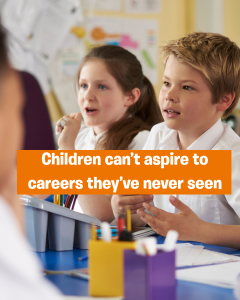
Ask a group of children what they want to be when they grow up and you will probably hear some familiar answers.
A doctor. A teacher. A footballer. A police officer. A YouTuber.
These are not bad aspirations, they are visible ones. They’re careers children see at home, at school, in their communities and through the media. But what about the thousands of other roles quietly shaping the world around them?
Research suggests that by the age of seven, most kids have started developing a narrow idea about the jobs that are “for them”. Those ideas are influenced less by the full range of opportunities available and more by the relatively small number of careers they regularly encounter.
Does that make us stop and think? Children do not choose from every possible career. They choose from the careers they know.
Visibility Shapes Aspiration
Imagine asking a child to choose their favourite flavour of ice cream after only ever tasting vanilla. They might genuinely believe vanilla is their favourite but have they really had a choice? Careers work in much the same way.
Children won’t be able to imagine themselves in roles they have never seen or heard about. Every day, they encounter teachers, nurses, firefighters and shopkeepers. They watch footballers on television, follow content creators online and see police officers in their communities. These careers feel real because they are visible and many others are not.
A reported 68% of adults in one Education and Employers study said they did not know their current job existed when they were at school. That figure shows just how many careers remain hidden during the years when children first begin forming ideas about their futures.
It is not only children who are unaware of these roles. Parents, carers and teachers may never have encountered them either. If the adults supporting children do not know that a career exists, it becomes much harder for them to introduce it, explain it or recognise the interests that might lead towards it.
As Andreas Schleicher, the OECD’s Director for Education and Skills, has said, children need to be aware of the world and the opportunities it offers them.
Awareness alone, however, isn’t the finish line. Careers become truly meaningful when a child can picture themselves doing them and when they stop thinking, “That’s somebody else’s job,” and begin thinking, “Maybe I could do that.”
The Hidden Careers That Build Our World
Behind every school, hospital, football stadium and new housing development are hundreds of professionals whose work most children never see. One of those professions quietly connects them all: surveying.
Before a building, road or community can be designed, someone first needs to measure, map and understand the land. Every school a child attends, every hospital they visit, every football stadium they cheer in and every new community they call home all began with that process. A surveyor was there first.
Yet ask a group of children what a surveyor does and most simply won’t know. Not because surveying is unimportant, but because they’ve never been shown the role it plays in shaping the world around them.
Surveying is far from the only profession that remains hidden from view. Environmental scientists monitor the ecosystems where children live and play. Urban planners shape safer neighbourhoods and future communities. GIS specialists use location data to support decisions about transport, healthcare and emergency response, while hydrographers map rivers, coastlines and the seabed. Drone pilots inspect infrastructure and gather information in places that would otherwise be difficult, expensive or dangerous to reach.
This Is Bigger Than Surveying
This conversation isn’t really about surveying, it’s about opportunity. When children only encounter a narrow range of careers, they don’t just miss out on discovering individual professions.They may never discover interests and strengths that could have led them towards work they genuinely love.A child who loves maps may never realise they would thrive in surveying. A fascination with rivers might never become hydrology. An interest in wildlife may never lead to ecology or conservation. The connection is never made because the career remains invisible.
That matters for children first, but the impact reaches much further. Many sectors are already facing skills shortages and need the next generation of engineers, scientists, planners, surveyors, geospatial professionals, ecologists, technicians and designers.
Yet this isn’t simply about filling vacancies. It’s about making sure every child has the opportunity to discover work that genuinely matches their interests, talents and curiosity.
No one is suggesting that primary school children should decide what they want to do for the rest of their lives. Childhood should be a time for exploring, changing interests and discovering new passions. But the wider the range of careers children encounter during those formative years, the more possibilities they have to imagine for themselves in the future.
Research from Education and Employers found that fewer than one percent of children said they had heard about the career they eventually drew from a volunteer visiting their school. At the same time, long-term studies suggest that the aspirations children develop during childhood and adolescence can influence later educational and employment outcomes. Together, those findings reinforce a simple but important idea: children don’t need to make career decisions early, but they do need the chance to discover what’s possible.
Making the Menu Bigger
The answer isn’t to tell children what they should become. It’s to help them discover what is possible.
That begins by introducing children to people and professions they may never otherwise encounter, revealing the hidden work behind the buildings, technology, transport systems and communities they use every day. It also means helping the adults around them discover those careers too, because parents, carers and teachers can only introduce opportunities they know exist themselves.
The more careers children encounter, the broader their understanding of the world becomes. Meeting people from different industries can challenge stereotypes about who belongs in particular professions, widen aspirations and help children imagine futures they may never have considered before.
Ultimately, success isn’t measured by how many children become surveyors, engineers or scientists. It’s measured by whether every child has had the opportunity to make an informed choice about their future. Whether they go on to work in surveying, medicine, teaching or a career none of us has even heard of yet matters far less than knowing those possibilities were there in the first place.
Helping Children See More
Broadening children’s awareness of careers doesn’t require every primary school lesson to become a careers lesson. In many cases, it can begin with something much simpler: helping children connect what they are already learning with the people who do it every day.
A geography lesson can become a conversation about surveying. A science topic might introduce environmental scientists or hydrologists. Designing a new community can open the door to planners, engineers and architects. Even an ordinary walk can prompt questions about who designed a bridge, mapped a footpath or protected a local habitat.
Parents, teachers, employers and professional bodies all have a role to play. Sometimes that role is as simple as sharing a story, answering a question, visiting a classroom or helping children see the hidden professions behind the places and technology they encounter every day.
Every new career a child discovers makes their view of the world a little bigger, and every conversation opens another possibility.
At Get Kids Into Survey, we’re working with teachers, parents, volunteers and industry to make one hidden profession a little more visible. Every classroom resource, school visit, ambassador talk and learning project is designed with one simple aim: to help children discover a career they may never otherwise have encountered.
We can’t show every child every career. But we can make sure surveying is no longer one of the invisible ones.
Because children can’t aspire to careers they’ve never seen.
Next in this series…
Curiosity Comes Before Careers
If visibility helps children discover careers, what helps them discover the interests that lead towards them?
In Part Two, we’ll explore why memorable projects, engaging stories and real-world experiences often inspire children long before job titles ever do.
This website uses cookies to improve your experience while you navigate through the website. Out of these, the cookies that are categorized as necessary are stored on your browser as they are essential for the working of basic functionalities of the website. We also use third-party cookies that help us analyze and understand how you use this website. These cookies will be stored in your browser only with your consent. You also have the option to opt-out of these cookies. But opting out of some of these cookies may affect your browsing experience.
Necessary cookies are absolutely essential for the website to function properly. This category only includes cookies that ensures basic functionalities and security features of the website. These cookies do not store any personal information.
Any cookies that may not be particularly necessary for the website to function and is used specifically to collect user personal data via analytics, ads, other embedded contents are termed as non-necessary cookies. It is mandatory to procure user consent prior to running these cookies on your website.
Translation Options Hotsheet Download
Please fill out the form below to access our Translation Options Hotsheet:
Monopoly Sponsor Info Sheet Download
Please fill out the form below to download our Monopoly Sponsor Info Sheet Download:
Autumn Poster Hotsheet Download
Please fill out the form below to access our Poster Hotsheet:
Summer Poster Hotsheet Download
Please fill out the form below to access our Poster Hotsheet:
Spring Poster Hotsheet Download
Please fill out the form below to access our Poster Hotsheet:
Poster Hotsheet Download
Please fill out the form below to access our Poster Hotsheet:
Re-Print Hotsheet Download
Please fill out the form below to access our Re-print Hotsheet:
Winter Poster Hotsheet Download
Please fill out the form below to access our Poster Hotsheet:
Homework Project Info Pack
Please fill out the form below to access our Homework Project Information Pack:


 Company name and location?
 Company name and location?
 Company name and location?
 Company Name and Location
 🦅
 The Hub is available to members of the Get Kids into Survey Brand Ambassador programme.
 Ask a group of children what they want to be when they grow up and you will probably hear some familiar answers.
 Company name and location? Subsea7, Worldwide